Paraboloid
Paraboloid
Jump to navigation
Jump to search

Paraboloid of revolution
In geometry, a paraboloid is a quadric surface that has (exactly) one axis of symmetry and no center of symmetry. The term "paraboloid" is derived from parabola, which refers to a conic section that has the same property of symmetry.
There are two kinds of paraboloids, elliptic and hyperbolic, depending on the nature of the planar cross sections: A paraboloid is elliptic if almost all cross sections are ellipses; it is hyperbolic if almost all cross sections are hyperbolas.
Equivalently, a paraboloid may be defined as a quadric surface that is not a cylinder, and has an implicit equation whose part of degree two may be factored over the complex numbers into two different linear factors. The paraboloid is hyperbolic if the factors are real and elliptic if the factors are complex conjugate.
An elliptic paraboloid is shaped like an oval cup and has a maximum or minimum point when its axis is vertical. In a suitable coordinate system with three axes x, y, and z, it can be represented by the equation[1]:892
- z=x2a2+y2b2.displaystyle z=frac x^2a^2+frac y^2b^2.
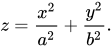
where a and b are constants that dictate the level of curvature in the xz and yz planes respectively. In this position, the elliptic paraboloid opens upward.
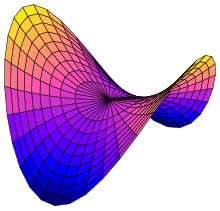
Hyperbolic paraboloid
A hyperbolic paraboloid (not to be confused with a hyperboloid) is a doubly ruled surface shaped like a saddle. In a suitable coordinate system, a hyperbolic paraboloid can be represented by the equation[2][3]:896
- z=y2b2−x2a2.displaystyle z=frac y^2b^2-frac x^2a^2.
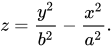
In this position, the hyperbolic paraboloid opens down along the x-axis and up along the y-axis (i.e., the parabola in the plane x = 0 opens upward and the parabola in the plane y=0 opens downward).
Obviously both the paraboloids contain a lot of parabolas. But there are essential differences, too: an elliptic paraboloid contains ellipses and a hyperbolic paraboloid hyperbolas (see section below).
Contents
1 Properties and applications
1.1 Elliptic paraboloid
1.2 Hyperbolic paraboloid
2 Plane sections of a paraboloid
2.1 Plane sections of an elliptic paraboloid
2.2 Plane sections of a hyperbolic paraboloid
3 Cylinder between pencils of elliptic and hyperbolic paraboloids
4 Curvature
5 Geometric representation of multiplication table
6 Dimensions of a paraboloidal dish
7 See also
8 References
Properties and applications[edit]
Elliptic paraboloid[edit]
With a = b an elliptic paraboloid is a paraboloid of revolution: a surface obtained by revolving a parabola around its axis. It is the shape of the parabolic reflectors used in mirrors, antenna dishes, and the like; and is also the shape of the surface of a rotating liquid, a principle used in liquid mirror telescopes and in making solid telescope mirrors (see rotating furnace). This shape is also called a circular paraboloid.
There is a point called the focus (or focal point) on the axis of a circular paraboloid such that, if the paraboloid is a mirror, light from a point source at the focus is reflected into a parallel beam, parallel to the axis of the paraboloid. This also works the other way around: a parallel beam of light incident on the paraboloid parallel to its axis is concentrated at the focal point. This applies also for other waves, hence parabolic antennas. For a geometrical proof, click here.
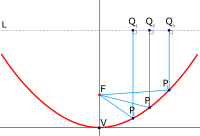
Parallel rays coming into a circular paraboloidal mirror are reflected to the focal point, F, or vice versa
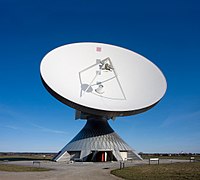
parabolic reflector
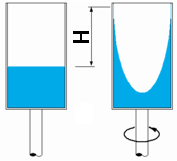
rotating water in a glass
Hyperbolic paraboloid[edit]
The hyperbolic paraboloid is a doubly ruled surface: it contains two families of mutually skew lines. The lines in each family are parallel to a common plane, but not to each other. Hence the hyperbolic paraboloid is a conoid.
These properties characterize hyperbolic paraboloids and are used in one of the oldest definitions of hyperbolic paraboloids: a hyperbolic paraboloid is a surface that may be generated by a moving line that is parallel to a fixed plane and crosses two fixed skew lines. This property makes it easy to physically shape a hyperbolic paraboloid out of concrete, and explains its frequent use in modern architecture, perhaps[weasel words] originally in Eastern European Constructivist structures.[citation needed]
The widely sold fried snack food Pringles potato chips resemble a truncated hyperbolic paraboloid.[4] The distinctive shape of these chips allows them to be stacked in sturdy tubular containers, fulfilling a design goal that they break less easily than other types of chip.[5]

The hyperbolic paraboloid is a doubly ruled surface, and thus can be used to construct a saddle roof from straight beams

Warszawa Ochota railway station, an example of a hyperbolic paraboloid structure

Pringles. An example of a hyperbolic paraboloid
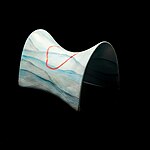
Surface illustrating a hyperbolic paraboloid


- Examples in architecture
- St. Mary's Cathedral, Tokyo
Cathedral of Saint Mary of the Assumption, San Francisco, California
Saddledome in Calgary, Alberta, Canada- London Velopark
- Dogra Hall, Indian Institute of Technology Delhi in New Delhi, India
Plane sections of a paraboloid[edit]
Plane sections of an elliptic paraboloid[edit]
As plane sections of an elliptic paraboloid with equation
- z=x2a2+y2b2displaystyle z=frac x^2a^2+frac y^2b^2
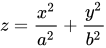
one gets the following cases:
- a parabola, if the plane is parallel to the z-axis,
- an ellipse or a point or empty, if the plane is not parallel to the z-axis.
- a point, if the plane is a tangent plane.
Obviously, any elliptic paraboloid of revolution contains circles. This is also true, but less obvious, in the general case (see circular section).
Remark: an elliptic paraboloid is projectively equivalent to a sphere.
Plane sections of a hyperbolic paraboloid[edit]
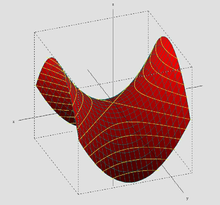
hyperbolic paraboloid with hyperbolas and parabolas
As plane sections of a hyperbolic paraboloid with equation
- z=x2a2−y2b2displaystyle z=frac x^2a^2-frac y^2b^2
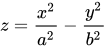
one gets the following cases:
- a parabola, if the plane is parallel to the z-axis with equation ux+vy+w=0, au≠±bvdisplaystyle ux+vy+w=0, auneq pm bv
,
- a line, if the plane is parallel to the z-axis with equation ux+vy+w=0, au=±bvdisplaystyle ux+vy+w=0, au=pm bv
,
- a pair of intersecting lines, if the plane is a tangent plane,
- a hyperbola, if the plane is not parallel to the z-axis and not a tangent plane.
Remarks:
- A hyperbolic paraboloid is a ruled surface (contains lines), but not developable (in this case it is unlike a cylinder or cone).
- The Gauss curvature at any point is negative. Hence it is a saddle surface.
- The unit hyperbolic paraboloid with equation z=x2−y2displaystyle z=x^2-y^2
can be represented by z=2xydisplaystyle z=2xy
after a rotation around the z-axis with an angle of 45° degrees.
- A hyperbolic paraboloid is projectively equivalent to a hyperboloid of one sheet.
Cylinder between pencils of elliptic and hyperbolic paraboloids[edit]

elliptic paraboloid, parabolic cylinder, hyperbolic paraboloid
The pencil
- z=x2+y2b2, b>0,displaystyle z=x^2+frac y^2b^2, b>0,
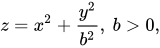
of elliptic paraboloids
and the pencil
- z=x2−y2b2, b>0,displaystyle z=x^2-frac y^2b^2, b>0,
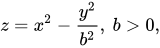
of hyperbolic paraboloids approach the same surface
- z=x2displaystyle z=x^2

for b→∞displaystyle brightarrow infty 
which is a parabolic cylinder (see image).
Curvature[edit]
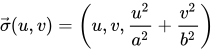
The elliptic paraboloid, parametrized simply as
- σ→(u,v)=(u,v,u2a2+v2b2)displaystyle vec sigma (u,v)=left(u,v,frac u^2a^2+frac v^2b^2right)
has Gaussian curvature
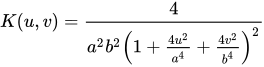
- K(u,v)=4a2b2(1+4u2a4+4v2b4)2displaystyle K(u,v)=frac 4a^2b^2left(1+frac 4u^2a^4+frac 4v^2b^4right)^2
and mean curvature
- H(u,v)=a2+b2+4u2a2+4v2b2a2b2(1+4u2a4+4v2b4)3displaystyle H(u,v)=frac a^2+b^2+frac 4u^2a^2+frac 4v^2b^2a^2b^2sqrt left(1+frac 4u^2a^4+frac 4v^2b^4right)^3
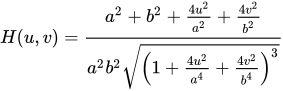
which are both always positive, have their maximum at the origin, become smaller as a point on the surface moves further away from the origin, and tend asymptotically to zero as the said point moves infinitely away from the origin.
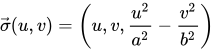
The hyperbolic paraboloid,[2] when parametrized as
- σ→(u,v)=(u,v,u2a2−v2b2)displaystyle vec sigma (u,v)=left(u,v,frac u^2a^2-frac v^2b^2right)
has Gaussian curvature
- K(u,v)=−4a2b2(1+4u2a4+4v2b4)2displaystyle K(u,v)=frac -4a^2b^2left(1+frac 4u^2a^4+frac 4v^2b^4right)^2
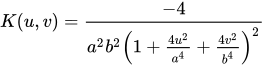
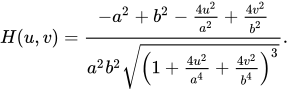
and mean curvature
- H(u,v)=−a2+b2−4u2a2+4v2b2a2b2(1+4u2a4+4v2b4)3.displaystyle H(u,v)=frac -a^2+b^2-frac 4u^2a^2+frac 4v^2b^2a^2b^2sqrt left(1+frac 4u^2a^4+frac 4v^2b^4right)^3.
Geometric representation of multiplication table[edit]
If the hyperbolic paraboloid
- z=x2a2−y2b2displaystyle z=frac x^2a^2-frac y^2b^2
is rotated by an angle of π/4 in the +z direction (according to the right hand rule), the result is the surface
- z=(x2+y22)(1a2−1b2)+xy(1a2+1b2)displaystyle z=left(frac x^2+y^22right)left(frac 1a^2-frac 1b^2right)+xyleft(frac 1a^2+frac 1b^2right)

and if a = b then this simplifies to
z=2xya2displaystyle z=frac 2xya^2.
Finally, letting a = √2, we see that the hyperbolic paraboloid
- z=x2−y22.displaystyle z=frac x^2-y^22.
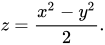
is congruent to the surface
- z=xydisplaystyle z=xy

which can be thought of as the geometric representation (a three-dimensional nomograph, as it were) of a multiplication table.
The two paraboloidal ℝ2 → ℝ functions
- z1(x,y)=x2−y22displaystyle z_1(x,y)=frac x^2-y^22

and
- z2(x,y)=xydisplaystyle z_2(x,y)=xy
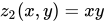
are harmonic conjugates, and together form the analytic function
- f(z)=z22=f(x+yi)=z1(x,y)+iz2(x,y)displaystyle f(z)=frac z^22=f(x+yi)=z_1(x,y)+iz_2(x,y)

which is the analytic continuation of the ℝ → ℝ parabolic function f(x) = x2/2.
Dimensions of a paraboloidal dish[edit]
The dimensions of a symmetrical paraboloidal dish are related by the equation
- 4FD=R2,displaystyle 4FD=R^2,

where F is the focal length, D is the depth of the dish (measured along the axis of symmetry from the vertex to the plane of the rim), and R is the radius of the rim. They must all be in the same unit of length. If two of these three lengths are known, this equation can be used to calculate the third.
A more complex calculation is needed to find the diameter of the dish measured along its surface. This is sometimes called the "linear diameter", and equals the diameter of a flat, circular sheet of material, usually metal, which is the right size to be cut and bent to make the dish. Two intermediate results are useful in the calculation: P = 2F (or the equivalent: P = R2/2D) and Q = √P2 + R2, where F, D, and R are defined as above. The diameter of the dish, measured along the surface, is then given by
- RQP+Pln(R+QP),displaystyle frac RQP+Pln left(frac R+QPright),
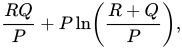
where ln x means the natural logarithm of x, i.e. its logarithm to base e.
The volume of the dish, the amount of liquid it could hold if the rim were horizontal and the vertex at the bottom (e.g. the capacity of a paraboloidal wok), is given by
- π2R2D,displaystyle frac pi 2R^2D,

where the symbols are defined as above. This can be compared with the formulae for the volumes of a cylinder (πR2D), a hemisphere (2π/3R2D, where D = R), and a cone (π/3R2D). πR2 is the aperture area of the dish, the area enclosed by the rim, which is proportional to the amount of sunlight a reflector dish can intercept. The surface area of a parabolic dish can be found using the area formula for a surface of revolution which gives
- A=πR((R2+4D2)3−R3)6D2.displaystyle A=frac pi Rleft(sqrt (R^2+4D^2)^3-R^3right)6D^2.

See also[edit]
- Ellipsoid
- Holophones
- Hyperboloid
- Hyperboloid structure
Liquid mirror telescope, paraboloids produced by rotation- Parabola
- Parabolic reflector
Parabolic reflector#Focus-balanced reflector, paraboloid with focus at centre of mass- Quadratic form
- Rotation of axes
- Saddle point
- Saddle roof
- Translation of axes
References[edit]
^ Thomas, George B.; Maurice D. Weir; Joel Hass; Frank R. Giordiano (2005). Thomas' Calculus 11th ed. Pearson Education, Inc. p. 892. ISBN 0-321-18558-7.
^ ab Weisstein, Eric W. "Hyperbolic Paraboloid." From MathWorld--A Wolfram Web Resource. http://mathworld.wolfram.com/HyperbolicParaboloid.html
^ Thomas, George B.; Maurice D. Weir; Joel Hass; Frank R. Giordiano (2005). Thomas' Calculus 11th ed. Pearson Education, Inc. p. 896. ISBN 0-321-18558-7.
^ Zill, Dennis G.; Wright, Warren S. (2011), Calculus: Early Transcendentals, Jones & Bartlett Publishers, p. 649, ISBN 9781449644482 .
^ Wyman, Carolyn (2004), "Pringles potato chips: A new use for tennis ball cans", Better Than Homemade: Amazing Foods that Changed the Way We Eat, Quirk Books, pp. 47–49, ISBN 9781931686426 .
Categories:
- Geometric shapes
- Surfaces
- Quadrics
- Parabolas


(window.RLQ=window.RLQ||).push(function()mw.config.set("wgPageParseReport":"limitreport":"cputime":"0.208","walltime":"0.340","ppvisitednodes":"value":1500,"limit":1000000,"ppgeneratednodes":"value":0,"limit":1500000,"postexpandincludesize":"value":20073,"limit":2097152,"templateargumentsize":"value":3425,"limit":2097152,"expansiondepth":"value":11,"limit":40,"expensivefunctioncount":"value":2,"limit":500,"unstrip-depth":"value":0,"limit":20,"unstrip-size":"value":12055,"limit":5000000,"entityaccesscount":"value":0,"limit":400,"timingprofile":["100.00% 191.815 1 -total"," 32.61% 62.546 1 Template:Reflist"," 26.12% 50.110 1 Template:Weasel-inline"," 18.80% 36.067 2 Template:Cite_book"," 18.46% 35.412 1 Template:Fix-span"," 15.60% 29.923 3 Template:Category_handler"," 10.69% 20.508 1 Template:Cn"," 10.37% 19.886 36 Template:Math"," 8.76% 16.795 1 Template:Fix"," 6.39% 12.256 2 Template:Citation"],"scribunto":"limitreport-timeusage":"value":"0.053","limit":"10.000","limitreport-memusage":"value":2461085,"limit":52428800,"cachereport":"origin":"mw1241","timestamp":"20180828152126","ttl":1900800,"transientcontent":false);mw.config.set("wgBackendResponseTime":93,"wgHostname":"mw1333"););

 Clash Royale CLAN TAG