Presidential Election 1860. Red shows states won by Lincoln/Hamlin, green by Breckinridge/Lane, orange by Bell/Everett, and blue by Douglas/Johnson
President before election James Buchanan
Elected President Abraham Lincoln
The United States Presidential Election of 1860 was the nineteenth quadrennial presidential election to select the President and Vice President of the United States. The election was held on Tuesday, November 6, 1860. In a four-way contest, the Republican Party ticket of Abraham Lincoln and Hannibal Hamlin emerged triumphant. The election of Lincoln served as the primary catalyst of the American Civil War.
The United States had become increasingly divided during the 1850s over sectional disagreements, especially regarding the extension of slavery into the territories. Incumbent President James Buchanan, like his predecessor Franklin Pierce, was a northern Democrat with sympathies for the South. During the mid-to-late 1850s, the anti-slavery Republican Party became a major political force in the wake of the Kansas–Nebraska Act and the Supreme Court's decision in the 1857 case of Dred Scott v. Sandford . By 1860, the Republican Party had replaced the defunct Whig Party as the major opposition to the Democrats. A group of former Whigs and Know Nothings formed the Constitutional Union Party, which sought to avoid secession by pushing aside the issue of slavery.
The 1860 Republican National Convention nominated Lincoln, a moderate former Congressman from Illinois, as its standard-bearer. The Republican Party platform promised not to interfere with slavery in the states, but opposed the further extension of slavery into the territories. The first 1860 Democratic National Convention adjourned without agreeing on a nominee, but a second convention nominated Senator Stephen A. Douglas of Illinois for president. Douglas's support for the concept of popular sovereignty, which called for each individual territory to decide on the status of slavery, alienated many Southern Democrats. The Southern Democrats, with the support of President Buchanan, held their own convention and nominated Vice President John C. Breckinridge of Kentucky for president. The 1860 Constitutional Union Convention nominated a ticket led by former Senator John Bell of Tennessee.
Despite minimal support in the South, Lincoln won a plurality of the popular vote and a majority of the electoral vote. The divisions among the Republicans' opponents were not in themselves decisive in ensuring the Republican capture of the White House, as Lincoln received absolute majorities in states that combined for a majority of the electoral votes. Lincoln's main opponent in the North was Douglas, who finished second in several states but only won the slave state of Missouri and three electors from the free state of New Jersey. Bell won three Southern states, while Breckinridge swept the remainder of the South. The election of Lincoln led to the secession of several states in the South, and the Civil War would begin with the Battle of Fort Sumter. The election was the first of six consecutive victories for the Republican Party.
Contents 1 Nominations 1.1 Democratic (Northern Democratic) Party nomination 1.1.1 Democratic Party candidates gallery 1.2 Southern Democratic Party nomination 1.2.1 Southern Democratic Party candidates gallery 1.3 Republican Party nomination 1.3.1 Republican Party candidates gallery 1.4 Constitutional Union Party nomination 1.5 Liberty (Union) Party nomination 1.5.1 Liberty Party (Radical Abolitionists, Union) candidates gallery 1.6 People's Party nomination 2 An election for disunion 3 Results 3.1 Geography of results 3.1.1 Cartographic gallery 4 Results by state 5 Trigger for the Civil War 6 See also 7 Notes 8 References 9 Bibliography 10 External links Nominations [ edit] The 1860 presidential election conventions were unusually tumultuous, due in particular to a split in the Democratic Party that led to rival conventions.
Democratic (Northern Democratic) Party nomination [ edit] This section does not cite any sources . Please help improve this section by adding citations to reliable sources. Unsourced material may be challenged and removed. (November 2017) (Learn how and when to remove this template message)
Main article: 1860 Democratic National Convention
Democratic Party Ticket, 1860 Stephen A. Douglas Herschel V. Johnson for President for Vice President (1847–1861) (1853–1857) Campaign
Northern Democratic candidates:
Stephen Douglas, Senator from Illinois James Guthrie, former Secretary Treasury from Kentucky Robert Mercer Taliaferro Hunter, Senator from Virginia Joseph Lane, Senator from Oregon Daniel S. Dickinson, former Senator from New York Andrew Johnson, Senator from Tennessee Democratic Party candidates gallery [ edit] Senator Stephen A. Douglas from Illinois
Former Treasury Secretary James Guthrie
Senator Robert M. T. Hunter from Virginia
Senator Joseph Lane from Oregon
Former Senator Daniel S. Dickinson from New York
Senator Andrew Johnson
The South Carolina Institute located in Charleston. The Institute hosted the Democratic National Convention and December Secession Convention in 1860.
[2] At the Democratic National Convention held in Institute Hall in Charleston, South Carolina, in April 1860, 51 Southern Democrats walked out over a platform dispute. The extreme pro-slavery "Fire-Eater" William Lowndes Yancey and the Alabama delegation first left the hall, followed by the delegates of Florida, Georgia, Louisiana, Mississippi, South Carolina, Texas, three of the four delegates from Arkansas, and one of the three delegates from Delaware.
Six candidates were nominated: Stephen A. Douglas from Illinois, James Guthrie from Kentucky, Robert Mercer Taliaferro Hunter from Virginia, Joseph Lane from Oregon, Daniel S. Dickinson from New York, and Andrew Johnson from Tennessee. Three other candidates, Isaac Toucey from Connecticut, James Pearce from Maryland, and Jefferson Davis from Mississippi (the future president of the Confederate States) also received votes.
Douglas/Johnson campaign poster
Douglas, a moderate on the slavery issue who favored "popular sovereignty", was ahead on the first ballot, but needed 56.5 more votes to secure the nomination. On the 57th ballot, Douglas was still ahead, but 51.5 votes short of the nomination. In desperation, the delegates agreed on May 3 to stop voting and adjourn the convention.
The Democrats convened again at the Front Street Theater in Baltimore, Maryland, on June 18. This time, 110 Southern delegates (led by "Fire-Eaters") walked out when the convention would not adopt a resolution supporting extending slavery into territories whose voters did not want it. Some considered Horatio Seymour a compromise candidate for the National Democratic nomination at the reconvening convention in Baltimore. Seymour wrote a letter to the editor of his local newspaper declaring unreservedly that he was not a candidate for either spot on the ticket. After two ballots, the remaining Democrats nominated Stephen A. Douglas from Illinois for president.
Benjamin Fitzpatrick from Alabama was nominated for vice president, but he refused the nomination. That nomination ultimately went instead to Herschel Vespasian Johnson from Georgia.
Southern Democratic Party nomination [ edit] Main article: 1860 Democratic National Convention
Southern Democratic Party Ticket, 1860 John C. Breckinridge Joseph Lane for President for Vice President (1857–1861) (1859–1861) Campaign
Southern Democratic candidates:
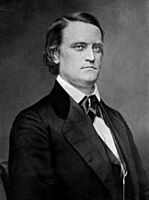
John C. Breckinridge, Vice President of the United States Daniel S. Dickinson, former Senator from New York Robert Mercer Taliaferro Hunter, Senator from Virginia Joseph Lane, Senator from Oregon Jefferson Davis, Senator from Mississippi Southern Democratic Party candidates gallery [ edit] Vice President John C. Breckinridge
Former SenatorDaniel S. Dickinson from New York
SenatorRobert M. T. Hunter from Virginia(declined to be nominated)
Senator Joseph Lane from Oregon(declined to be nominated)
Senator Jefferson Davis from Mississippi(declined to be nominated)
Maryland Institute Hall, Baltimore. Here bolting delegates nominated Breckinridge before Richmond vote
[3] The Charleston bolters reconvened in Richmond, Virginia on June 11. When the Democrats reconvened in Baltimore, they rejoined (except South Carolina and Florida, who stayed in Richmond).
When the convention seated two replacement delegations on June 18, they bolted again, now accompanied by nearly all other Southern delegates, as well as erstwhile Convention chair Caleb Cushing, a New Englander and former member of Franklin Pierce's cabinet. This larger group met immediately in Baltimore's Institute Hall, with Cushing again presiding. They adopted the pro-slavery platform rejected at Charleston, and nominated Vice President John C. Breckinridge for President, and Senator Joseph Lane from Oregon for Vice President.[4]
Yancey and some (less than half) of the bolters, almost entirely from the Lower South, met on June 28 in Richmond, along with the South Carolina and Florida delegations. This convention affirmed the nominations of Breckinridge and Lane.[3]
Besides the Democratic Parties in the southern states, the Breckinridge/Lane ticket was also supported by the Buchanan administration. Buchanan's own continued prestige in his home state of Pennsylvania ensured that Breckinridge would be the principal Democratic candidate in that populous state. Breckinridge was the last sitting Vice President nominated for President until Richard Nixon in 1960.
Republican Party nomination [ edit] Main article: 1860 Republican National Convention
Republican Party Ticket, 1860 Abraham Lincoln Hannibal Hamlin for President for Vice President Former U.S. Representative(1847–1849) (1848–1857 & 1857–1861) Campaign
Republican candidates:
Abraham Lincoln, former representative from Illinois William Seward, Senator from New York Simon Cameron, Senator from Pennsylvania Salmon P. Chase, Governor of Ohio Edward Bates, former representative from Missouri John McLean, Associate Justice of the U.S. Supreme Court Benjamin Wade, Senator from Ohio William L. Dayton, former Senator from New Jersey Republican Party candidates gallery [ edit] Former Representative Abraham Lincoln
Senator William H. Seward from New York
Senator Simon Cameron
Governor Salmon P. Chase
Former Representative Edward Bates from Missouri
Associate Justice John McLean
Senator Benjamin Wade from Ohio
Former Senator William L. Dayton from New Jersey
Chicago Wigwam, Republican Convention
The Republican National Convention met in mid-May 1860 after the Democrats had been forced to adjourn their convention in Charleston. With the Democrats in disarray and a sweep of the Northern states possible, the Republicans felt confident going into their convention in Chicago. William H. Seward from New York was considered the front-runner, followed by Abraham Lincoln from Illinois, Salmon P. Chase from Ohio, and Missouri's Edward Bates.
As the convention developed, however, it was revealed that Seward, Chase, and Bates had each alienated factions of the Republican Party. Delegates were concerned that Seward was too closely identified with the radical wing of the party, and his moves toward the center had alienated the radicals. Chase, a former Democrat, had alienated many of the former Whigs by his coalition with the Democrats in the late 1840s. He had also opposed tariffs demanded by Pennsylvania, and critically, had opposition from his own delegation from Ohio. Bates outlined his positions on the extension of slavery into the territories and equal constitutional rights for all citizens, positions that alienated his supporters in the border states and Southern conservatives. German Americans in the party opposed Bates because of his past association with the Know Nothings.
Since it was essential to carry the West, and because Lincoln had a national reputation from his debates and speeches as the most articulate moderate, he won the party's nomination for president on the third ballot on May 18, 1860. Senator Hannibal Hamlin from Maine was nominated for vice-president, defeating Cassius Clay from Kentucky.
The party platform[5] promised not to interfere with slavery in the states, but opposed slavery in the territories. The platform promised tariffs protecting industry and workers, a Homestead Act granting free farmland in the West to settlers, and the funding of a transcontinental railroad. There was no mention of Mormonism (which had been condemned in the Party's 1856 platform), the Fugitive Slave Act, personal liberty laws, or the Dred Scott decision.[6] While the Seward forces were disappointed at the nomination of a little-known western upstart, they rallied behind Lincoln. Abolitionists, however, were angry at the selection of a moderate and had little faith in Lincoln.[7] [8]
Constitutional Union Party nomination [ edit] Main article: 1860 Constitutional Union Convention
Constitutional Union Party Ticket, 1860 John Bell Edward Everett for President for Vice President Former U.S. Senator from Tennessee(1847–1859) Former U.S. Senator from Massachusetts(1853–1854) Campaign
Constitutional Union candidates:
John Bell, former Senator from Tennessee Sam Houston, Governor of Texas John J. Crittenden, Senator from Kentucky Edward Everett, former Senator from Massachusetts William A. Graham, former Senator from North Carolina William C. Rives, former Senator from Virginia Former Senator John Bell of Tennessee
Governor Sam Houston of Texas
Senator John J. Crittenden from Kentucky
Former Senator Edward Everett from Massachusetts
Former Senator William A. Graham from North Carolina
Former Senator William C. Rives from Virginia
A Constitutional Union campaign poster, 1860, portraying John Bell and Edward Everett, respectively the candidates for President and Vice-President. Once Lincoln was inaugurated and called up the militia, Bell supported the secession of Tennessee. In 1863, Everett dedicated the new cemetery at Gettysburg.
The Constitutional Union Party was formed by remnants of both the defunct Know Nothing and Whig Parties who were unwilling to join either the Republicans or the Democrats. The new party's members hoped to stave off Southern secession by avoiding the slavery issue.[9] They met in the Eastside District Courthouse of Baltimore and nominated John Bell from Tennessee for president over Governor Sam Houston of Texas on the second ballot. Edward Everett was nominated for vice-president at the convention on May 9, 1860, one week before Lincoln.[10] [11]
John Bell was a former Whig who had opposed the Kansas–Nebraska Act and the Lecompton Constitution. Edward Everett had been president of Harvard University and Secretary of State in the Fillmore administration. The party platform advocated compromise to save the Union with the slogan "The Union as it is, and the Constitution as it is."[12]
Liberty (Union) Party nomination [ edit] Liberty (Union) candidates:
Gerrit Smith, former representative from New York Liberty Party (Radical Abolitionists, Union) candidates gallery [ edit] Former Representative Gerrit Smith from New York
By 1860, very little remained of the Liberty Party, after most of its membership left to join the Free Soil Party in 1848 and nearly all of what remained of it joined the Republicans in 1854. The remaining party was also called the Radical Abolitionists.[13] [14] A convention of one hundred delegates was held in Convention Hall, Syracuse, New York, on August 29, 1860. Delegates were in attendance from New York, Pennsylvania, New Jersey, Michigan, Illinois, Ohio, Kentucky, and Massachusetts. Several of the delegates were women.
Gerrit Smith, a prominent abolitionist and the 1848 presidential nominee of the original Liberty Party, had sent a letter in which he stated that his health had been so poor that he had not been able to be away from home since 1858. Nonetheless, he remained popular in the party because he had helped inspire some of John Brown's supporters at the Raid on Harpers Ferry. In his letter, Smith donated $50 to pay for the printing of ballots in the various states.
There was quite a spirited contest between the friends of Gerrit Smith and William Goodell in regard to the nomination for the presidency. In spite of his professed ill health, Gerrit Smith was nominated for president and Samuel McFarland from Pennsylvania was nominated for vice president.[14]
In Ohio, a slate of presidential electors pledged to Smith ran with the name of the Union Party.[15]
People's Party nomination [ edit] Governor Sam Houston of Texas
The People's Party was a loose association of the supporters of Governor Samuel Houston. On April 20, 1860, the party held what it termed a national convention to nominate Houston for president on the San Jacinto Battlefield in Texas. Houston's supporters at the gathering did not nominate a vice-presidential candidate, since they expected later gatherings to carry out that function. Later mass meetings were held in northern cities, such as New York City on May 30, 1860, but they too failed to nominate a vice-presidential candidate. Houston, never enthusiastic about running for the Presidency, soon became convinced that he had no chance of winning and that his candidacy would only make it easier for the Republican candidate to win. He withdrew from the race on August 16 and urged the formation of a Unified "Union" ticket in opposition to Lincoln.[16] [17]
An election for disunion [ edit] Slavery Northwest Ordinance Kentucky and Virginia Resolutions Battle of Negro Fort Missouri Compromise Tariff of 1828 Nat Turner's slave rebellion Nullification Crisis The Amistad Prigg v. Pennsylvania Texas annexation Mexican–American War Wilmot Proviso Manifest destiny Underground Railroad Nashville Convention Compromise of 1850 Fugitive Slave Act of 1850 Uncle Tom's Cabin Kansas–Nebraska Act Ostend Manifesto Bleeding Kansas Caning of Charles Sumner Dred Scott v. Sandford The Impending Crisis of the South Brown's raid on Harpers Ferry 1860 presidential election Crittenden Compromise Secession of Southern States Star of the West Corwin Amendment Morrill Tariff Battle of Fort Sumter
In their campaigning, Bell and Douglas both claimed that disunion would not necessarily follow a Lincoln election. Nonetheless, loyal army officers in Virginia, Kansas and South Carolina warned Lincoln of military preparations to the contrary. Secessionists threw their support behind Breckinridge in an attempt either to force the anti-Republican candidates to coordinate their electoral votes or throw the election into the House of Representatives, where the selection of the president would be made by the representatives elected in 1858, before the Republican majorities in both House and Senate achieved in 1860 were seated in the new 37th Congress. Mexican War hero Winfield Scott suggested to Lincoln that he assume the powers of a commander-in-chief before inauguration. However, historian Bruce Chadwick observes that Lincoln and his advisors ignored the widespread alarms and threats of secession as mere election trickery.[citation needed
Indeed, voting in the South was not as monolithic as the Electoral College map would make it seem. Economically, culturally, and politically, the South was made up of three regions. In the states of the "Upper" South, later known as the "Border States" (Delaware, Maryland, Kentucky, and Missouri along with the Kansas territories), unionist popular votes were scattered among Lincoln, Douglas, and Bell, to form a majority in all four. In the "Middle" South states, there was a unionist majority divided between Douglas and Bell in Virginia and Tennessee; in North Carolina and Arkansas, the unionist (Bell and Douglas) vote approached a majority. Texas was the only Middle South state that Breckinridge carried convincingly. In three of the six "Deep" South, unionists (Bell and Douglas) won divided majorities in Georgia and Louisiana or neared it in Alabama. Breckinridge convincingly carried only three of the six states of the Deep South (South Carolina, Florida, and Mississippi).[18] These three Deep South states were all among the four Southern states with the lowest white populations; together, they held only nine-percent of Southern whites.[19]
Among the slave states, the three states with the highest voter turnouts voted the most one-sided. Texas, with five percent of the total wartime South's population, voted 75 percent Breckinridge. Kentucky and Missouri, with one-fourth the total population, voted 73 percent pro-union Bell, Douglas and Lincoln. In comparison, the six states of the Deep South making up one-fourth the Confederate voting population, split 57 percent Breckinridge versus 43 percent for the two pro-union candidates.[nb 1] The four states that were admitted to the Confederacy after Fort Sumter held almost half its population, and voted a narrow combined majority of 53 percent for the pro-union candidates.
In the eleven states that would later declare their secession from the Union and be controlled by Confederate armies, ballots for Lincoln were cast only in Virginia,[nb 2] [18] [22] Unsurprisingly, the vast majority of the votes Lincoln received were cast in border counties of what would soon become West Virginia - the future state accounted for 1,832 of Lincoln's 1,929 votes.[23]
Lincoln received no votes at all in 121 of the state's then-145 counties (including 31 of the 50 that would form West Virginia), received a single vote in three counties and received ten or fewer votes in nine of the 24 counties where he polled votes. Lincoln's best results, by far, were in the four counties that comprised the state's northern panhandle, a region which had long felt alienated from Richmond and which was economically and culturally linked to its neighbors Ohio and Pennsylvania and which would become the key driver in the successful effort to form a separate state. Hancock County (Virginia's northernmost at the time) returned Lincoln's best result - he polled over 40% of the vote there and finished in second place (Lincoln polled only eight votes fewer than Breckinridge). Of the 97 votes cast for Lincoln in the state's post-1863 boundaries, 93 were polled in four counties (all along the Potomac River) and four were tallied in the coastal city of Portsmouth.[18]
Some key differences between modern elections and the those of the mid-nineteenth century are that at the time, there was no secret ballot anywhere in the United States, that candidates were responsible for printing and distributing their own ballots (a service that was typically done by supportive newspaper publishers) and that in order to distribute valid ballots for a presidential election in a state, candidates needed citizens eligible to vote in that state who would pledge to vote for the candidate in the Electoral College. This meant that even if a voter had access to a ballot for Lincoln, casting one in favor of him in a strongly pro-slavery county would incur (at minimum) social ostracization (of course, casting a vote for Breckinridge in a strongly abolitionist county ran a voter the same risk). In ten southern slave states, no citizen would publicly pledge to vote for Abraham Lincoln. In most of Virginia, no publisher would print ballots for Lincoln's pledged electors.[18]
In the four slave states that did not secede (Missouri, Kentucky, Maryland, and Delaware), Lincoln came in fourth in every state except Delaware (where he finished third). Within the fifteen slave states, Lincoln won only two counties out of 996, Missouri's St. Louis and Gasconade Counties.[18] In the 1856 election, the Republican candidate for president had received no votes at all in twelve of the fourteen slave states with a popular vote (these being the same states as in the 1860 election, plus Missouri and Virginia).
Results [ edit] Inauguration of Abraham Lincoln
state Election results
The election was held on Tuesday, November 6, 1860, and was noteworthy for exaggerated sectionalism in a country that was soon to dissolve into civil war. Voter turnout was 81.2%, the highest in American history up to that time, and the second-highest overall (exceeded only in the election of 1876).[24] [25] All six Presidents elected since Andrew Jackson won re-election in 1832 had been one-term presidents, the last four with a popular vote under 51 percent.[26]
Results by county, with darker shades indicating larger percentages for the winning candidate. Red is for Lincoln (Republican), blue is for Douglas (Northern Democratic), green is for Breckinridge (Southern Democratic), yellow is for Bell (Constitutional Union), and purple is for "Fusion" (Non-Republican/Democratic Fusion). South Carolina had no popular vote.
Lincoln won the Electoral College with less than 40 percent of the popular vote nationwide by carrying states above the Mason–Dixon line and north of the Ohio River, plus the states of California and Oregon in the Far West. Unlike every preceding president-elect, Lincoln did not carry even one slave state, and indeed he was not on the ballot in 10 of the southern states: Alabama, Arkansas, Florida, Georgia, Louisiana, Mississippi, North Carolina, South Carolina, Tennessee, and Texas. He was the first President-elect to not be on the ballot in all states, a feat which has since been equalled thrice[nb 3] but never to the same extent. Lincoln won the second lowest share of the popular vote among all winning presidential candidates in U.S. history.[nb 4]
The Republican victory resulted from the concentration of votes in the free states, which together controlled a majority of the presidential electors.[27] Lincoln's strategy was deliberately focused, in collaboration with Republican Party Chairman Thurlow Weed, on expanding on the states Frémont won four years earlier. New York was critical with 35 Electoral College votes, 11.5 percent of the total; with Pennsylvania (27) and Ohio (23), a candidate could collect more than half (85) of the votes needed. The Wide Awakes young Republican men's organization massively expanded registered voter lists, and although Lincoln was not even on the ballot in most southern states, population increases in the free states had far exceeded those seen in the slave states for many years before the election of 1860, hence free states dominated in the Electoral College.[28]
The split in the Democratic party is sometimes held responsible for Lincoln's victory,[29] however, despite the fact that Lincoln won the election with less than forty percent of the popular vote, much of the anti-Republican vote was "wasted" in Southern states where Lincoln was not even on the ballot. At most, a single opponent nationwide would only have deprived Lincoln of California, Oregon, and four New Jersey electors,[30] whose combined total of eleven electoral votes would have made no difference to the result; every other state won by the Republicans was won by a clear majority of the vote. In the four states of New York, Rhode Island, Pennsylvania and New Jersey where anti-Lincoln votes did combine into fusion tickets, Lincoln still won three and split New Jersey.[31] If the opposition had formed fusion tickets in every state, Lincoln still would have received 169 electoral votes, 17 more than the 152 required to win the Electoral College.[32] [33]
Like Lincoln, Breckinridge and Bell won no electoral votes outside of their respective sections. While Bell retired to his family business, quietly supporting his state's secession, Breckinridge served as a Confederate general. He finished second in the Electoral College with 72 votes, carrying eleven of fifteen slave states (including South Carolina, whose electors were chosen by the state legislature, not popular vote). Breckinridge stood a distant third in national popular vote at eighteen percent, but accrued 50–75 percent in the first seven states that would become the Confederate States of America. He took nine of the eleven states that eventually joined, plus the border slave states of Delaware and Maryland, losing only Virginia and Tennessee. Breckinridge received very little support in the free states, showing some strength only in California, Oregon, Pennsylvania and Connecticut.
Bell carried three slave states (Tennessee, Kentucky, and Virginia) and lost Maryland by only 722 votes. Nevertheless, he finished a remarkable second in all slave states won by Breckinridge and Douglas. He won 45 to 47 percent in Maryland, Tennessee and North Carolina and canvassed respectably with 36 to 40 percent in Missouri, Arkansas, Louisiana, Georgia, and Florida. It was hoped by Bell himself that he would take over the former support of the extinct Whig Party in free states, but the majority of this support went to Lincoln.[34] Thus, except for running mate Everett's home state of Massachusetts, and California, Bell received even less support in the free states than did Breckinridge, and consequently came in last in the national popular vote at 12 percent.
Douglas was the only candidate who won electoral votes in both slave and free states (free New Jersey and slave Missouri). His support was the most widespread geographically; he finished second behind Lincoln in the popular vote with 29.5 percent, but last in the Electoral College. Douglas attained a 28–47 percent share in the states of the Mid-Atlantic, Midwest and Trans-Mississippi West, but slipped to 19–39 percent in New England. Outside his regional section, Douglas took 15–17 percent of the popular vote total in the slave states of Kentucky, Alabama and Louisiana, then 10 percent or less in the nine remaining slave states. Douglas, in his "Norfolk Doctrine", reiterated in North Carolina, promised to keep the Union together by coercion if states proceeded to secede. The popular vote for Lincoln and Douglas combined was seventy percent of the turnout.
The 1860 Republican ticket was the first successful national ticket that did not feature a Southerner, and the election marked the end of Southern political dominance in the United States. Between 1789 and 1860, Southerners had been President for two-thirds of the era, and had held the offices of Speaker of the House and President pro tem of the Senate during much of that time. Moreover, since 1791, Southerners had comprised a majority of the Supreme Court.[35]
Presidential candidate Party Home state Popular vote(a) Electoral Running mate Count Percentage Vice-presidential candidate Home state Electoral vote Abraham Lincoln 1,865,908 39.82% 180 Hannibal Hamlin 180 John C. Breckinridge 848,019 18.10% 72 Joseph Lane 72 John Bell 590,901 12.61% 39 Edward Everett 39 Stephen A. Douglas 1,380,202 29.46% 12 Herschel Vespasian Johnson 12 Other 531 0.01% — Other — Total 4,685,561 100% 303 303 Needed to win 152 152
Source (Popular Vote): Leip, David. "1860 Presidential Election Results". Dave Leip's Atlas of U.S. Presidential Elections . Retrieved July 27, 2005 . .mw-parser-output cite.citationfont-style:inherit.mw-parser-output qquotes:"""""""'""'".mw-parser-output code.cs1-codecolor:inherit;background:inherit;border:inherit;padding:inherit.mw-parser-output .cs1-lock-free abackground:url("//upload.wikimedia.org/wikipedia/commons/thumb/6/65/Lock-green.svg/9px-Lock-green.svg.png")no-repeat;background-position:right .1em center.mw-parser-output .cs1-lock-limited a,.mw-parser-output .cs1-lock-registration abackground:url("//upload.wikimedia.org/wikipedia/commons/thumb/d/d6/Lock-gray-alt-2.svg/9px-Lock-gray-alt-2.svg.png")no-repeat;background-position:right .1em center.mw-parser-output .cs1-lock-subscription abackground:url("//upload.wikimedia.org/wikipedia/commons/thumb/a/aa/Lock-red-alt-2.svg/9px-Lock-red-alt-2.svg.png")no-repeat;background-position:right .1em center.mw-parser-output .cs1-subscription,.mw-parser-output .cs1-registrationcolor:#555.mw-parser-output .cs1-subscription span,.mw-parser-output .cs1-registration spanborder-bottom:1px dotted;cursor:help.mw-parser-output .cs1-hidden-errordisplay:none;font-size:100%.mw-parser-output .cs1-visible-errorfont-size:100%.mw-parser-output .cs1-subscription,.mw-parser-output .cs1-registration,.mw-parser-output .cs1-formatfont-size:95%.mw-parser-output .cs1-kern-left,.mw-parser-output .cs1-kern-wl-leftpadding-left:0.2em.mw-parser-output .cs1-kern-right,.mw-parser-output .cs1-kern-wl-rightpadding-right:0.2emSource (Electoral Vote): "Electoral College Box Scores 1789–1996". National Archives and Records Administration. Retrieved July 31, 2005 .
(a) The popular vote figures exclude South Carolina where the Electors were chosen by the state legislature rather than by popular vote.
Popular vote Lincoln
39.82% Douglas
29.46% Breckinridge
18.10% Bell
12.61% Others
0.01%
Electoral vote Lincoln
59.41% Breckinridge
23.76% Bell
12.87% Douglas
3.96%
Geography of results [ edit] Cartographic gallery [ edit] Map of presidential election results by county
Map of Republican presidential election results by county
Map of Northern Democratic presidential election results by county
Map of Southern Democratic presidential election results by county
Map of Constitutional Union presidential election results by county
Map of "Fusion" slate presidential election results by county
Cartogram of presidential election results by county
Cartogram of Republican presidential election results by county
Cartogram of Northern Democratic presidential election results by county
Cartogram of Southern Democratic presidential election results by county
Cartogram of Constitutional Union presidential election results by county
Cartogram of "Fusion" slate presidential election results by county
Results by state [ edit] Source: Data from Walter Dean Burnham, Presidential ballots, 1836–1892 (Johns Hopkins University Press, 1955) pp 247–57.
Abraham Lincoln Stephen Douglas John Breckinridge John Bell Fusion Margin State Total State electoral # % electoral # % electoral # % electoral # % electoral # % electoral # % # 9 no ballots 00013618 13,61815.1 - 00048669 48,66954.0 9 27,835 30.9 - no ballots -20,834 -23.1 90,122 AL 4 no ballots 5,357 9.9 - 28,732 53.1 4 20,063 37.0 - no ballots -28,732 -16.1 54,152 AR 4 38,733 32.3 4 37,999 31.7 - 33,969 28.4 - 9,111 7.6 - no ballots 734 0.6 119,812 CA 6 43,488 58.1 6 15,431 20.6 - 14,372 19.2 - 1,528 2.0 - no ballots 28,057 37.5 74,819 CT 3 3,822 23.7 - 1,066 6.6 - 7,339 45.5 3 3,888 24.1 - no ballots -3,451 -21.4 16,115 DE 3 no ballots 223 1.7 - 8,277 62.2 3 4,801 36.1 - no ballots -3,476 -26.1 13,301 FL 10 no ballots 11,581 10.9 - 52,176 48.9 10 42,960 40.3 - no ballots -9,216 -8.6 106,717 GA 11 172,171 50.7 11 160,215 47.2 - 2,331 0.7 - 4,914 1.4 - no ballots 11,956 3.5 339,631 IL 13 139,033 51.1 13 115,509 42.4 - 12,295 4.5 - 5,306 1.9 - no ballots 23,524 8.7 272,143 IN 4 70,302 54.6 4 55,639 43.2 - 1,035 0.8 - 1,763 1.4 - no ballots 14,663 13.4 128,739 IA 12 1,364 0.9 - 25,651 17.5 - 53,143 36.3 - 66,058 45.2 12 no ballots 12,915 -8.9 146,216 KY 6 no ballots 7,625 15.1 - 22,681 44.9 6 20,204 40.0 - no ballots -2,477 -4.9 50,510 LA 8 62,811 62.2 8 29,693 29.4 - 6,368 6.3 - 2,046 2.0 - no ballots 33,118 32.8 100,918 ME 8 2,294 2.5 - 5,966 6.4 - 42,482 45.9 8 41,760 45.1 - no ballots -722 -0.8 92,502 MD 13 106,684 62.9 13 34,370 20.3 - 6,163 3.6 - 22,331 13.2 - no ballots 72,314 42.6 169,548 MA 6 88,481 57.2 6 65,057 42.0 - 805 0.5 - 415 0.3 - no ballots 23,424 15.2 154,758 MI 4 22,069 63.4 4 11,920 34.3 - 748 2.2 - 50 0.1 - no ballots 10,149 29.1 34,787 MN 7 no ballots 3,282 4.7 - 40,768 59.0 7 25,045 36.2 - no ballots -15,723 -22.8 69,095 MS 9 17,028 10.3 - 58,801 35.5 9 31,362 18.9 - 58,372 35.3 - no ballots -429 -0.2 165,563 MO 5 37,519 56.9 5 25,887 39.3 - 2,125 3.2 - 412 0.6 - no ballots -11,632 20.6 65,943 NH 7 58,346 48.1 4[nb 5] no ballots 3[nb 6] no ballots - no ballots - 62,869[nb 7] 51.9 -[nb 8] -4,523 -3.8 121,215 NJ 35 362,646 53.7 35 no ballots - no ballots - no ballots - 312,510 46.3 -[nb 9] 50,136 7.4 675,156 NY 10 no ballots 2,737 2.8 - 48,846 50.5 10 45,129 46.7 - no ballots -3,717 -3.8 96,712 NC 23 231,709 51.2 23 187,421 42.3 - 11,406 2.6 - 12,194 2.8 - no ballots 44,288 8.9 442,730 OH 3 5,329 36.1 3 4,136 28.0 - 5,075 34.4 - 218 1.5 - no ballots 254 1.7 14,758 OR 27 268,030 56.3 27 16,765 3.5 -[nb 10] no ballots 12,776 2.7 - 178,871[nb 11] 37.5 -[nb 12] 89,159 18.8 476,442 PA 4 12,244 61.4 4 7,707[nb 13] 38.6 - no ballots no ballots no ballots 4,537 22.8 19,951 RI 8 no popular vote no popular vote no popular vote 8 no popular vote no popular vote - - - SC 12 no ballots 11,281 7.7 - 65,097 44.6 - 69,728 47.7 12 no ballots -4,631 -3.1 146,106 TN 4 no ballots 18 0.0 - 47,454 75.5 4 15,383 24.5 - no ballots -32,071 -51.0 62,855 TX 5 33,808 75.8 5 8,649 19.4 - 1,866 4.2 - 217 0.5 - no ballots 25,159 56.4 44,644 VT 15 1,887 1.1 - 16,198 9.7 - 74,325 44.5 - 74,481 44.6 15 no ballots -156 -0.1 166,891 VA 5 86,110 56.6 5 65,021 42.7 - 887 0.6 - 161 0.1 - no ballots 21,089 13.9 152,179 WI TOTALS: 303 1,865,908 39.8 180 1,004,823 21.5 12 669,148 14.3 72 590,901 12.6 39 554,250 11.8 0 4,685,030 US TO WIN: 152
Trigger for the Civil War [ edit] See also: Origins of the American Civil War and Presidency of James Buchanan § Secession
The election of Abraham Lincoln in 1860 was an immediate cause of secession of the first 7 Southern states (SC, MS, FL, AL, GA, LA, TX), which formed the Confederacy in February 1861. The statehood of Kansas as a free state and Lincoln's military resistance to the Confederacy led to secession of 4 more states (VA, NC, TN, AR) after May 1861. Lincoln had been the nominee of the Republican party with an anti-slavery expansion platform, he refused to acknowledge the right to secession, and he would not yield federal property within Southern states. Numerous historians have explored the reasons so many white Southerners adopted secessionism in 1860, after 30 years of disputes between North and South states over protection tariffs, Federal spending, and civil rights of refusing to allow slaves to travel with slaveholder families in some North States. Tariffs had been levied on South imports to protect North industries, taxes were charged on South cotton but not North wool, or 3-to-1 Federal expenditures on North navigation lighthouses versus the South's longer coastline, and a faked slave uprising in Virginia angered many Southerners.[38] [39] Bertram Wyatt-Brown argues that secessionists desired independence as necessary for their honor. They could no longer tolerate Northern state attitudes that regarded slave ownership as a great sin and Northern politicians who insisted on stopping the spread of slavery.[40] [41] Avery Craven argues that secessionists believed Lincoln's election meant long-term doom for their vast social system, of thousands of Southerners working with over two million slaves living in private households as nearly half the population of many Southern states in 1860. This situation could not be solved by the democratic process, and it placed "the great masses of men, North and South, helpless before the drift into war".[42]
See also [ edit] American election campaigns in the 19th century Electoral history of Abraham Lincoln History of the United States (1849–1865) History of the United States Democratic Party History of the United States Republican Party John Hanks Third Party System United States House of Representatives elections, 1860 United States Senate elections, 1860 First inauguration of Abraham Lincoln Notes [ edit] ^ "Deep South" here in presidential popular votes refers to Georgia, Florida, Alabama, Mississippi and Louisiana. It excludes South Carolina from the calculation, because in 1860 it chose presidential electors in the state legislature, without a popular vote. ^ Ballots were printed sheets, usually printed by the party, with the name of the candidate(s) and the names of presidential electors who were pledged to that presidential candidate. Voters brought the ballot to the polling station and dropped it publicly into the election box. In order to receive any votes, a candidate (or his party) had to have ballots printed and organize a group of electors pledged to that candidate. Except in some border areas, the Republican party did not attempt any organization in the South and did not print ballots there because almost no one was willing to acknowledge publicly they were voting for Lincoln for fear of violent retribution.[20] [21] ^ In 1892, Grover Cleveland was not on the ballot in Colorado, Idaho, Kansas, North Dakota, or Wyoming, whilst neither Harry Truman in 1948 nor Lyndon Johnson in 1964 were on the ballot in Alabama. ^ John Quincy Adams, who won the 1824 presidential election in a vote of the House of Representatives, won 30.9% of the popular vote, less than the share received by Andrew Jackson. Lincoln's share of the popular vote in 1860 represents the lowest share received by any popular vote winner. ^ 4 of the electors pledged to Lincoln were elected since the Breckinridge and Bell electors finished behind all other candidates.[36] ^ The 3 Douglas electors were elected.[36] ^ The Fusion vote used here is the vote for the high elector on the slate, who was pledged to Douglas.[36] ^ The Fusion slate consisted of 3 electors pledged to Douglas, and 2 each to Breckinridge and Bell. Nonetheless, different electors appeared in some counties for Breckinridge and Bell, resulting in lower totals for them and a split electoral outcome. The 3 Douglas electors were elected and 4 of those pledged to Lincoln. The Breckinridge and Bell electors finished behind all other candidates.[36] ^ The slate of electors were pledged to 3 different candidates: 18 to Douglas, 10 to Bell, and 7 to Breckinridge.[36] ^ Not all of the Douglas supporters agreed to the Reading slate deal and established a separate Douglas only ticket. This slate comprised the 12 Douglas electoral candidates on the Reading ticket, and 15 additional Douglas supporters. This ticket was usually referred to as the Straight Douglas ticket. Thus 12 electoral candidates appeared on 2 tickets, Reading and Straight Douglas.[37] ^ This vote is listed under the Fusion column, not the Breckinridge column as many other sources do, because this ticket was pledged to either of two candidates based on the national result. Additionally, the slate was almost equally divided between the supporters of Breckinridge and Douglas.[37] ^ The Democratic Party chose its slate of electors before the National Convention in Charleston, SC. Since this was decided before the party split, both Douglas supporters and Breckinridge supporters claimed the right for their man to be considered the party candidate and the support of the electoral slate. Eventually, the state party worked out an agreement: if either candidate could win the national election with Pennsylvania's electoral vote, then all her electoral votes would go to that candidate. Of the 27 electoral candidates, 15 were Breckinridge supporters; the remaining 12 were for Douglas. This was often referred to as the Reading electoral slate, because it was in that city that the state party chose it.[37] ^ The Douglas ticket in Rhode Island was supported by Breckinridge and Bell supporters.[37] References [ edit] ^ "Voter Turnout in Presidential Elections". The American Presidency Project . UC Santa Barbara. ^ Lossing, Benson John. Pictorial history of the civil war in the United States of America, Volume 1 (1866) Poughkeepsie, NY. Free ebook. viewed January 26, 2012. Bolters met at St. Andrew's Hall. ^ a b Freehling, William W., The Road to Disunion: Secessionists Triumphant, Vol.2. Oxford University, 2007, p. 321 ^ Heidler, p. 157. Baltimore's Institute Hall, not be confused with Charleston's Institute Hall also used by the walk-out delegations. ^ "Republican National Platform, 1860". Central Pacific Railroad Photographic History Museum . CPRR.org. 2003-04-13. Retrieved 2015-04-17 . ^ Rhodes (1920) 2:420 ^ Rhodes (1920) 2:429 ^ Baum, Dale (1984). The Civil War Party System: The Case of Massachusetts, 1848–1876 . Chapel Hill: The University of North Carolina Press. p. 49. ISBN 0-8078-1588-8. ^ Schulten, Susan (2010-11-10). "How (And Where) Lincoln Won". New York Times , November 10, 2010. Retrieved from http://opinionator.blogs.nytimes.com/2010/11/10/how-and-where-lincoln-won/. ^ Lossing, Benson John, Pictorial History of the Civil War in the United States of America, Volume 1 (1866) Poughkeepsie, NY. Free ebook. viewed January 26, 2012. p. 29 Bolters met at St. Andrew's Hall. ^ The building had been the First Presbyterian Meeting House (Two Towers Church) on Fayette Street, between Calvert and North Street, demolished before 1866 and occupied by the United States Courthouse. ^ Getting the Message Out! Stephen A. Douglas Archived January 20, 2015, at the Wayback Machine. ^ Proceedings of the Convention of Radical Political Abolitionists, held at Syracuse, N. Y., June 26th, 27th, and 28th, 1855 , New York: Central Abolition Board, 1855^ a b "RADICAL ABOLITION NATIONAL CONVENTION". Douglass' Monthly . October 1860. p. 352. ^ "US President - Liberty (Union) National Convention". Our Campaigns . November 24, 2008. ^ "POLITICAL MOVEMENTS.; THE HOUSTON MASS MEETING. Large Gathering of the People in Union-Square--Washington statue Illuminated. The Hero of San Jacinto Nominated for the Presidency. Speeches, Address, Resolutions, Music, Fireworks, Guns, and Fun". The New York Times . May 30, 1860. ^ "Letter from Sam Houston Withdrawing from the Canvass". The New York Times . September 3, 1860. ^ a b c d e "HarpWeek 1860 Election Overview". Retrieved 2011-03-20 . ^ Freehling, William W., The Road to Disunion: Volume II. Secessionists Triumphant, 1854–1861, Oxford University Press, 2004, p. 447. ^ "Republican ballot 1860". Retrieved 2011-04-28 . ^ "Election of 1860 – 'Read Your Ballot' ". Retrieved 2011-04-28 . ^ "1860 Election Returns in Virginia, by County" (PDF) . Retrieved 2011-04-28 . ^ Results by county in Virginia ^ The 1876 election had a turnout of 81.8%, slightly higher than 1860. Between 1828 and 1928: "Voter Turnout in Presidential Elections: 1828–2008". The American Presidency Project . UC Santa Barbara. Retrieved 2012-11-09 . ^ Data between 1932 and 2008: "Table 397. Participation in Elections for President and U.S. Representatives: 1932 to 2010" (PDF) . U.S. Census Bureau, Statistical Abstract of the United States: 2012 . U.S. Census Bureau. Archived from the original (PDF) on October 24, 2012. Retrieved February 7, 2013 . ^ http://www.uselectionatlas.org/RESULTS/ Only Franklin Pierce had achieved a statistical majority in the popular vote (50.83 percent). ^ Chadwick, Bruce. "Lincoln for President: an unlikely candidate, an audacious strategy, and the victory no one saw coming" (2009) Ch. 10 The Eleventh Hour . p. 289 ^ Ziegler-McPherson, Christina A.; Selling America : Immigration Promotion and the Settlement of the American Continent, 1607-1914 , pp. 34-36 ^ e.g. , the 1912 Catholic Encyclopedia , vol, 15, p. 171^ "New Jersey's Vote in 1860". NY Times. December 26, 1892. ^ Allan Nevins, The Emergence of Lincoln: Prologue to Civil War (1950), p. 312 ^ Potter, The impending crisis, 1848–1861 (1976) p. 437 ^ Luthin, The First Lincoln Campaign p. 227 ^ Davies, Gareth and Zelizer, Julian E.; America at the Ballot Box: Elections and Political History , pp. 65-66 ^ Murrin, John M.; Johnson, Paul E.; McPherson, James M.; Fahs, Alice; Gerstle, Gary; Rosenberg, Emily S.; Rosenberg, Norman L. Liberty Equality Power: A History of the American People, Volume I: To 1877 (6th ed.). Boston: Wadsworth, Cengage Learning. p. 403. ISBN 0-495-91587-4. ^ a b c d e Dubin, Michael J., United States Presidential Elections, 1788–1860: The Official Results by County and State, McFarland & Company, 2002, p. 187 ^ a b c d Dubin, Michael J., United States Presidential Elections, 1788–1860: The Official Results by County and State, McFarland & Company, 2002, p. 188 ^ E. Merton Coulter (1950). The Confederate States of America, 1861--1865: A History of the South . p. 13. Retrieved 2017-10-03 . ^ Mary A. Decredico, "Sectionalism and the Secession Crisis," in John b. Boles, ed., A Companion to the American South (2004) pp. 240 ^ Decredico, p. 243 ^ Wyatt-Brown, Bertram. Yankee Saints and Southern Sinners (1990) ^ Avery Craven, The Growth of Southern Nationalism, 1848–1861 , 1953. Bibliography [ edit] Carwardine, Richard (2003). Lincoln . Pearson Education Ltd. ISBN 978-0-582-03279-8. Chadwick, Bruce (2010). Lincoln for President: An Unlikely Candidate, An Audacious Strategy, and the Victory No One Saw Coming . Sourcebooks, Inc. ISBN 978-1-4022-2858-2. Decredico, Mary A. "Sectionalism and the Secession Crisis," in John b. Boles, ed., A Companion to the American South (2004) pp. 231-248, on the historiography of Southend motivations Donald, David Herbert (1996) [1995]. Lincoln . New York: Simon and Schuster. ISBN 978-0-684-82535-9. Egerton, Douglas (2010). Year of Meteors: Stephen Douglas, Abraham Lincoln, and the Election That Brought on the Civil War . Bloomsbury Press. ISBN 978-1-59691-619-7. Foner, Eric (1995) [1970]. Free Soil, Free Labor, Free Men: The Ideology of the Republican Party before the Civil War . Oxford University Press. ISBN 978-0-19-509497-8. Fuller, A. James, ed. The Election of 1860 Reconsidered (Kent State Univ Press, 2013); 288pp; essays by scholars; online Goodwin, Doris Kearns (2002). Team of Rivals: The Political Genius of Abraham Lincoln . New York: Simon & Schuster. ISBN 0-684-82490-6. Green, Michael S. (2011). Lincoln and the Election of 1860 . SIU Press. ISBN 978-0-8093-8636-9. Grinspan, Jon, "'Young Men for War': The Wide Awakes and Lincoln's 1860 Presidential Campaign," Journal of American History 96.2 (2009): online. Harris, William C. (2007). Lincoln's Rise to the Presidency . Lawrence: University Press of Kansas. ISBN 978-0-7006-1520-9. Holt, Michael F. (1978). The Political Crisis of the 1850s . Holt, Michael F. The Election of 1860: "A Campaign Fraught with Consequences (2017) Holzer, Harold (2004). Lincoln at Cooper Union: The Speech That Made Abraham Lincoln President . Simon & Schuster. ISBN 978-0-7432-9964-0. Johannsen, Robert W. Stephen A. Douglas (1973), standard biography Luebke, Frederick C. (1971). Ethnic Voters and the Election of Lincoln . Luthin, Reinhard H. (1944). The First Lincoln Campaign . Cambridge, MA: Harvard University Press. ISBN 978-0-8446-1292-8. along with Nevins, the most detailed narrative of the electionOrdeal of the Union (10 volumes, Macmillan, 1979–2018), detailed scholarly coverage of every election, 1848 to 1864.The Disruption of American Democracy (1948), pp. 348–506, focused on the Democratic partyParks, Joseph Howard. John Bell of Tennessee (1950), standard biography Potter, David M. (1976). The impending crisis, 1848–1861 . HarperCollins. ISBN 978-0-06-131929-7. Rhodes, James Ford (1920). History of the United States from the Compromise of 1859 to the McKinley-Bryan Campaign of 1896 . vol. 2, ch. 11. highly detailed narrative covering 1856–60External links [ edit] Wikimedia Commons has media related to United States presidential election, 1860
Encyclopædia Britannica 1860 election: State-by-state Popular vote results 1860 popular vote by counties United States Presidential Election of 1860 in Encyclopedia Virginia Election of 1860 Electoral Map from 1860 Lincoln's election – details Report on 1860 Republican convention Overview of Constitutional Union National Convention Election of 1860 in Counting the Votes (1856 ←) United States presidential election, 1860 (1864 →)
Republican Party Convention
Nominee VP nominee Candidates Edward Bates Simon Cameron Salmon P. Chase William L. Dayton John McLean William H. Seward Benjamin Wade
Democratic Party Conventions
Northern Nominee Northern VP nominee Southern Nominee Southern VP nominee Candidates Daniel S. Dickinson James Guthrie Robert M. T. Hunter Andrew Johnson
Constitutional Union Party Convention
Nominee VP nominee Candidates John J. Crittenden William A. Graham Sam Houston William C. Rives
Other 1860 elections : HouseSenate
State results of the 1860 U.S. presidential election
Alabama Arkansas California Connecticut Delaware Florida Georgia Illinois Indiana Iowa Kentucky Louisiana Maine Maryland Massachusetts Michigan Minnesota Mississippi Missouri New Hampshire New Jersey New York North Carolina Ohio Oregon Pennsylvania Rhode Island South Carolina Tennessee Texas Vermont Virginia Wisconsin
Categories:
History of the United States (1849–65) Presidency of Abraham Lincoln Secession crisis of 1860–61 United States presidential election, 1860 November 1860 events Hidden categories:
Webarchive template wayback links CS1: Julian–Gregorian uncertainty Articles with short description Use mdy dates from April 2018 Pages using deprecated image syntax Elections using electoral votes Articles needing additional references from November 2017 All articles needing additional references All articles with unsourced statements Articles with unsourced statements from April 2018 Pages using bar box without float left or float right Articles with Encyclopædia Britannica links
Navigation menu Personal tools Not logged in Talk Contributions Create account Log in
Navigation Main page Contents Featured content Current events Random article Donate to Wikipedia Wikipedia store Interaction Help About Wikipedia Community portal Recent changes Contact page Tools What links here Related changes Upload file Special pages Permanent link Page information Wikidata item Cite this page Print/export Create a book Download as PDF Printable version Languages العربية Dansk Deutsch Español فارسی Français 한국어 Italiano עברית Kiswahili Latina Bahasa Melayu Nederlands 日本語 Norsk Polski Português Română Русский Simple English Suomi Svenska Українська 中文 Edit links

 2.3 pp