Nijūmon
Nijūmon
Jump to navigation
Jump to search

A nijūmon (the sanmon of Tōfuku-ji, a National Treasure)
The nijūmon (二重門, lit. two-story gate) is one of two types of two-story gate presently used in Japan (the other one being the rōmon, see photo in the gallery below), and can be found at most Japanese Buddhist temples.[1] This gate is distinguishable from its relative by the roof above the first floor which skirts the entire upper story, absent in a rōmon.[2] Accordingly, it has a series of brackets (tokyō) supporting the roof's eaves both at the first and at the second story.[3] In a rōmon, the brackets support a balcony. The tokyō are usually three-stepped (mitesaki) with tail rafters at the third step.[4][3] A nijūmon is normally covered by a hip-and-gable roof.[2]
Unlike a rōmon, whose second story is inaccessible and unusable, a nijūmon has stairs leading to the second story. Some gates have at their ends two sanrō (山廊), 2 x 1 bay structures housing the stairs.[2] The second story of a nijūmon usually contains statues of Shakyamuni or of goddess Kannon, and of the 16 Rakan, and hosts periodical religious ceremonies.[5] Large nijūmon' are 5 bays wide, 2 bays deep and have three entrances, however Tokyo's Zōjō-ji, the Tokugawa clan's funerary temple, has a gate which is 5 x 3 bays.[2] Smaller ones are 3 x 2 bays and have one, two or even three entrances.[2]
Of all temple gate types, the nujūmon has the highest status, and is accordingly used for important gates like the chūmon (middle gate) of ancient temples as Hōryū-ji.[3] The sanmon, the gate of a Zen temple of highest prestige, is usually a nijūmon.[note 1] Some nijūmon are called chūmon (中門, lit. middle gate) because they are situated between the entrance and the temple.[2]
Contents
1 Gallery
2 The second story of a nijūmon
3 Notes
4 References
5 Bibliography
Gallery[edit]
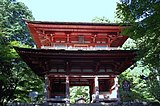
The Niōmon of Kōmyō-ji in Ayabe (National Treasure)

A nijūmon. Note the double roof.

A rōmon. Note the balcony and the single roof.
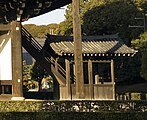
One of the sanrō of Tōfuku-ji's sanmon (detail of the photo above)


The second story of a nijūmon[edit]
Some interior images of the second story of a nijūmon, in this case Kōmyō-ji's sanmon in Kamakura, Kanagawa prefecture.

The sanmon
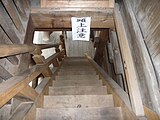
The stairs to the second story

The second story
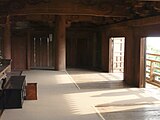
Second story, exit to the balcony

Sacred images in the main room


Notes[edit]
^ The term sanmon originated at Zen temples, but is often used by other sects too, particularly by the Jōdo sect.
References[edit]
^ Fujita & Koga 2008, pp. 84–85
^ abcdef "nijuumon". JAANUS – Japanese Architecture and Art Net User System. Retrieved 2010-06-22..mw-parser-output cite.citationfont-style:inherit.mw-parser-output qquotes:"""""""'""'".mw-parser-output code.cs1-codecolor:inherit;background:inherit;border:inherit;padding:inherit.mw-parser-output .cs1-lock-free abackground:url("//upload.wikimedia.org/wikipedia/commons/thumb/6/65/Lock-green.svg/9px-Lock-green.svg.png")no-repeat;background-position:right .1em center.mw-parser-output .cs1-lock-limited a,.mw-parser-output .cs1-lock-registration abackground:url("//upload.wikimedia.org/wikipedia/commons/thumb/d/d6/Lock-gray-alt-2.svg/9px-Lock-gray-alt-2.svg.png")no-repeat;background-position:right .1em center.mw-parser-output .cs1-lock-subscription abackground:url("//upload.wikimedia.org/wikipedia/commons/thumb/a/aa/Lock-red-alt-2.svg/9px-Lock-red-alt-2.svg.png")no-repeat;background-position:right .1em center.mw-parser-output .cs1-subscription,.mw-parser-output .cs1-registrationcolor:#555.mw-parser-output .cs1-subscription span,.mw-parser-output .cs1-registration spanborder-bottom:1px dotted;cursor:help.mw-parser-output .cs1-hidden-errordisplay:none;font-size:100%.mw-parser-output .cs1-visible-errorfont-size:100%.mw-parser-output .cs1-subscription,.mw-parser-output .cs1-registration,.mw-parser-output .cs1-formatfont-size:95%.mw-parser-output .cs1-kern-left,.mw-parser-output .cs1-kern-wl-leftpadding-left:0.2em.mw-parser-output .cs1-kern-right,.mw-parser-output .cs1-kern-wl-rightpadding-right:0.2em
^ abc Hamashima, Masashi (1999). Jisha Kenchiku no Kanshō Kiso Chishiki (in Japanese). Tokyo: Shibundō. pp. 105–107.
^ For details, see the article Tokyō.
^ Iwanami Nihonshi Jiten
Bibliography[edit]
Iwanami Nihonshi Jiten (岩波日本史辞典), CD-Rom Version. Iwanami Shoten, 1999-2001 (in Japanese)
"Nijuumon". JAANUS – Japanese Architecture and Art Net User System. Retrieved 2009-06-19.
Fujita Masaya, Koga Shūsaku, ed. (April 10, 1990). Nihon Kenchiku-shi (in Japanese) (September 30, 2008 ed.). Shōwa-dō. ISBN 4-8122-9805-9.
 | Wikimedia Commons has media related to Nijūmon. |
Elements of Japanese architecture | |||||
|---|---|---|---|---|---|
| Styles |
|  Model of Himeji Castle | |||
| Types of building |
| ||||
| Roof styles |
| ||||
| Structural |
| ||||
|
| ||||
| Rooms |
| ||||
| Furnishings |
| ||||
| Outdoor objects |
| ||||
| Measurements |
| ||||
| Organizations |
| ||||
| Related topics |
| ||||
Categories:
- Gates in Japan
- Japanese architectural features
- Japanese architecture
- Buddhism in Japan
- Buddhist architecture


(window.RLQ=window.RLQ||).push(function()mw.config.set("wgPageParseReport":"limitreport":"cputime":"0.316","walltime":"0.409","ppvisitednodes":"value":1158,"limit":1000000,"ppgeneratednodes":"value":0,"limit":1500000,"postexpandincludesize":"value":78823,"limit":2097152,"templateargumentsize":"value":7134,"limit":2097152,"expansiondepth":"value":10,"limit":40,"expensivefunctioncount":"value":0,"limit":500,"unstrip-depth":"value":1,"limit":20,"unstrip-size":"value":17663,"limit":5000000,"entityaccesscount":"value":1,"limit":400,"timingprofile":["100.00% 314.293 1 -total"," 24.67% 77.542 2 Template:Cite_web"," 12.44% 39.092 5 Template:Navbox"," 10.22% 32.127 2 Template:Nihongo"," 9.72% 30.541 1 Template:Buddhist_temples_in_Japan"," 9.47% 29.763 1 Template:Japanese_architectural_elements"," 8.85% 27.810 1 Template:Navbox_with_collapsible_groups"," 8.58% 26.978 1 Template:Commons_category"," 8.07% 25.359 3 Template:Category_handler"," 7.48% 23.496 1 Template:Main"],"scribunto":"limitreport-timeusage":"value":"0.117","limit":"10.000","limitreport-memusage":"value":3101883,"limit":52428800,"cachereport":"origin":"mw2269","timestamp":"20180930163354","ttl":1900800,"transientcontent":false);mw.config.set("wgBackendResponseTime":79,"wgHostname":"mw2241"););
 Clash Royale CLAN TAG