Presidential election results map. Blue denotes those won by Obama/Biden, red denotes states won by Romney/Ryan. Numbers indicate electoral votes allotted to the winner of each state.
President before election Barack Obama
Elected President Barack Obama
Part of a series on the 2012 U.S. presidential election Timeline General election debates Democratic Party Candidates Primaries Nominee Convention Republican Party Prelude Candidates Debates and forums Primaries National polling Statewide polling Straw Results Nominee Convention Endorsements Minor parties
Candidates Primaries Nominee Convention Primaries Nominee Convention Endorsements Americans Elect All candidates
The United States presidential election of 2012 was the 57th quadrennial American presidential election. It was held on Tuesday, November 6, 2012. The Democratic nominee, President Barack Obama, and his running mate, Vice President Joe Biden, were elected to a second term. They defeated the Republican ticket of former Governor Mitt Romney of Massachusetts and Representative Paul Ryan of Wisconsin.
As the incumbent president, Obama secured the Democratic nomination with no serious opposition. The Republicans experienced a competitive primary. Romney was consistently competitive in the polls and won the support of many party leaders, but he faced challenges from a number of more conservative contenders. Romney clinched his party's nomination in May, defeating Rick Santorum, Newt Gingrich, and several other candidates.
The campaigns focused heavily on domestic issues, and debate centered largely around sound responses to the Great Recession. Other issues included long-term federal budget issues, the future of social insurance programs, and the Affordable Care Act, Obama's marquee legislative program. Foreign policy was also discussed, including the phase-out of the Iraq War, military spending, the Iranian nuclear program, and appropriate counteractions to terrorism. The campaign was marked by a sharp rise in fundraising, including from nominally independent Super PACs.
Obama defeated Romney, winning a majority of both the popular vote and the Electoral College. Obama won 51.1% of the popular vote compared to Romney's 47.2%. Obama was the first incumbent since Franklin D. Roosevelt in 1944 to win reelection with fewer electoral votes and a lower popular vote percentage than had been won in the previous election, and was also the first two-term president since Ronald Reagan to win both his presidential bids with a majority of the nationwide popular vote.
Contents 1 State changes to voter registration and electoral rules 2 Nominations 2.1 Democratic Party 2.1.1 Primaries 2.1.2 Candidate 2.2 Republican Party 2.2.1 Primaries 2.2.2 Candidate 2.2.3 Withdrawn candidates 2.3 Third party and other nominations 2.3.1 Libertarian Party 2.3.2 Green Party 2.3.3 Constitution Party 2.3.4 Justice Party 2.3.4.1 Candidates gallery 3 Campaigns 3.1 Ballot access 3.2 Financing and advertising 3.3 Party conventions 3.4 Debates 3.5 Notable expressions, phrases, and statements 4 Results 4.1 Results by state 4.1.1 Maine and Nebraska district results 4.2 Close races 4.3 Romney's concession 4.4 Reactions 5 Voter demographics 6 Analysis 7 Maps 8 Gallery 9 See also 10 References 11 Further reading 12 External links State changes to voter registration and electoral rules [ edit] In 2011, several state legislatures passed new voting laws, especially pertaining to voter identification, with the stated purpose of combating voter fraud; the laws were attacked, however, by the Democratic Party as attempts to suppress voting among its supporters and to improve the Republican Party's presidential prospects. Florida, Georgia, Ohio,[2] Tennessee, and West Virginia's state legislatures approved measures to shorten early voting periods. Florida and Iowa barred all felons from voting. Kansas, South Carolina,[3] Tennessee, Texas[4] and Wisconsin[5] state legislatures passed laws requiring voters to have government-issued IDs before they could cast their ballots. This meant, typically, that people without driver's licenses or passports had to gain new forms of ID. Obama, the NAACP, and the Democratic Party fought against many of the new state laws.[6] Former President Bill Clinton denounced them, saying, "There has never been in my lifetime, since we got rid of the poll tax and all the Jim Crow burdens on voting, the determined effort to limit the franchise that we see today".[7] He was referring to Jim Crow laws passed in southern states near the turn of the twentieth century that disenfranchised most blacks from voting and excluded them from the political process for more than six decades. Clinton said the moves would effectively disenfranchise core voter blocs that trend liberal, including college students, Blacks, and Latinos.[8] [9] Rolling Stone magazine criticized the American Legislative Exchange Council (ALEC) for lobbying in states to bring about these laws, to "solve" a problem that does not exist.[6] The Obama campaign fought against the Ohio law, pushing for a petition and statewide referendum to repeal it in time for the 2012 election.[10]
In addition, the Pennsylvania legislature proposed a plan to change its representation in the electoral college from the traditional winner-take-all model to a district-by-district model.[11] As the governorship and both houses of its legislature were Republican-controlled, the move was viewed by some as an attempt to reduce Democratic chances.[12] [13] [14]
Nominations [ edit] Democratic Party [ edit] Main articles: Democratic Party presidential primaries, 2012 and 2012 Democratic National Convention
Primaries [ edit] With an incumbent president running for re-election against token opposition, the race for the Democratic nomination was largely uneventful. The nomination process consisted of primaries and caucuses, held by the 50 states, as well as Guam, Puerto Rico, Washington, D.C., U.S. Virgin Islands, American Samoa, and Democrats Abroad. Additionally, high-ranking party members known as superdelegates each received one vote in the convention. A few of the primary challengers surpassed the president's vote total in individual counties in several of the seven contested primaries, though none made a significant impact in the delegate count. Running unopposed everywhere else, President Obama cemented his status as the Democratic presumptive nominee on April 3, 2012, by securing the minimum number of pledged delegates needed to obtain the nomination.[15] [16]
Candidate [ edit] Main article: Democratic Party presidential candidates, 2012
Democratic Party ticket, 2012 Barack Obama Joe Biden for President for Vice President (2009–2017) (2009–2017) Campaign
Republican Party [ edit] Main articles: Republican Party presidential primaries, 2012; Prelude to the Republican presidential primaries, 2012; Republican Party presidential debates, 2012; and 2012 Republican National Convention
Primaries [ edit] Candidates with considerable name recognition who entered the race for the Republican presidential nomination in the early stages of the primary campaign included Representative and former Libertarian nominee Ron Paul, former Minnesota Governor Tim Pawlenty, who co-chaired John McCain's campaign in 2008, former Massachusetts Governor Mitt Romney, the runner-up for the nomination in the 2008 cycle, and former Speaker of the House Newt Gingrich.
The first debate took place on May 5, 2011, in Greenville, South Carolina, with businessman Herman Cain, former New Mexico Governor Gary Johnson, Ron Paul, Tim Pawlenty, and former Pennsylvania Senator Rick Santorum participating. Another debate took place a month later, with Newt Gingrich, Mitt Romney, former Utah Governor Jon Huntsman, and Rep. Michele Bachmann participating, and Gary Johnson excluded. A total of thirteen debates were held before the Iowa caucuses.
The first major event of the campaign was the Ames Straw Poll, which took place in Iowa on August 13, 2011. Michele Bachmann won the straw poll (this ultimately proved to be the acme of her campaign).[17] Pawlenty withdrew from the race after a poor showing in the straw poll, as did Thaddeus McCotter, the only candidate among those who qualified for the ballot who was refused entrance into the debate.[18]
It became clear at around this point in the nomination process that while Romney was considered to be the likely nominee by the Republican establishment, a large segment of the conservative primary electorate found him to be too moderate for their political views. As a result, a number of potential "anti-Romney" candidates were put forward,[19] [20] including future President Donald Trump,[21] Sarah Palin,[22] Chris Christie,[23] and Texas Governor Rick Perry,[24] the last of whom decided to run in August 2011. Perry did poorly in the debates, however, and Herman Cain and then Newt Gingrich came into the fore in October and November.
Due to a number of scandals, Cain withdrew just before the end of the year, after having gotten on the ballot in several states.[25] Around the same time, Johnson, who had been able to get into only one other debate, withdrew to seek the Libertarian Party nomination.[26]
For the first time in modern Republican Party history, three different candidates won the first three state contests in January (the Iowa caucuses, the New Hampshire primary, and the South Carolina primary).[27] Although Romney had been expected to win in at least Iowa and New Hampshire, Rick Santorum won the non-binding poll at caucus sites in Iowa by 34 votes, as near as can be determined from the incomplete tally, earning him a declaration as winner by state party leaders, although vote totals were missing from eight precincts.[28] [29] The election of county delegates at the caucuses would eventually lead to Ron Paul earning 22 of the 28 Iowa delegates to the Republican National Convention.[30] Newt Gingrich won South Carolina by a surprisingly large margin,[31] and Romney won only in New Hampshire.
A number of candidates dropped out at this point in the nomination process. Bachmann withdrew after finishing sixth in the Iowa caucuses,[32] Huntsman withdrew after coming in third in New Hampshire, and Perry withdrew when polls showed him drawing low numbers in South Carolina.[33]
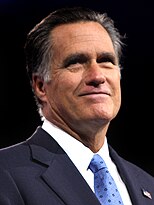
Mitt Romney on the campaign trail
Santorum, who had previously run an essentially one-state campaign in Iowa, was able to organize a national campaign after his surprising victory there. He unexpectedly carried three states in a row on February 7 and overtook Romney in nationwide opinion polls, becoming the only candidate in the race to effectively challenge the notion that Romney was the inevitable nominee.[34] However, Romney won all of the other contests between South Carolina and the Super Tuesday primaries, and regained his first-place status in nationwide opinion polls by the end of February.
The Super Tuesday primaries took place on March 6. Romney carried six states, Santorum carried three, and Gingrich won only in his home state of Georgia.[35] Throughout the rest of March, 266 delegates were allocated in 12 events, including the territorial contests and the first local conventions that allocated delegates (Wyoming's county conventions). Santorum won Kansas and three Southern primaries, but he was unable to make any substantial gain on Romney, who became a formidable frontrunner after securing more than half of the delegates allocated in March.
On April 10, Santorum suspended his campaign due to a variety of reasons, such as a low delegate count, unfavorable polls in his home state of Pennsylvania, and his daughter's health, leaving Mitt Romney as the undisputed front-runner for the presidential nomination and allowing Gingrich to claim that he was "the last conservative standing" in the campaign for the nomination.[36] After disappointing results in the April 24 primaries (finishing second in one state, third in three, and fourth in one), Gingrich dropped out on May 2 in a move that was seen as an effective end to the nomination contest.[37] After Gingrich's spokesman announced his upcoming withdrawal, the Republican National Committee declared Romney the party's presumptive nominee.[38] Ron Paul officially remained in the race, but he stopped campaigning on May 14 to focus on state conventions.
On May 29, after winning the Texas primary, Romney had received a sufficient number of delegates to clinch the party's nomination with the inclusion of unpledged delegates. After winning the June 5 primaries in California and several other states, Romney had received more than enough pledged delegates to clinch the nomination without counting unpledged delegates, making the June 26 Utah Primary, the last contest of the cycle, purely symbolic. CNN's final delegate estimate, released on July 27, 2012, put Romney at 1,462 pledged delegates and 62 unpledged delegates, for a total estimate of 1,524 delegates. No other candidate had unpledged delegates. The delegate estimates for the other candidates were Santorum at 261 delegates, Paul at 154, Gingrich at 142, Bachmann at 1, Huntsman at 1, and all others at 0.[39]
On August 28, 2012, delegates at the Republican National Convention officially named Romney the party's presidential nominee.[40] Romney formally accepted the delegates' nomination on August 30, 2012.[41]
Candidate [ edit] Republican Party ticket, 2012 Mitt Romney Paul Ryan for President for Vice President (2003–2007) (1999–present ) Campaign [42] [43]
Withdrawn candidates [ edit] Main article: Republican Party presidential candidates, 2012
[44] [45] [46] [47] (withdrew on May 2, 2012, and endorsed Mitt Romney)[48] [49] [50] [51] [52] [53] (withdrew on February 22, 2012, to run for the nominations of Americans Elect and the Reform Party, then endorsed Gary Johnson)[54] [55] [56] [57] [58] [59] [60] [61] [62] [63] [64] [65] [66] [67] [68] [69] Ron Paul
Political consultant and gay rights activistFred Karger
Former SpeakerNewt Gingrich ,
Former SenatorRick Santorum
Former GovernorBuddy Roemer
Rick Perry
Former AmbassadorJon Huntsman ,
Michele Bachmann
Former GovernorGary Johnson
BusinessmanHerman Cain ,
Thaddeus McCotter
Former GovernorTim Pawlenty
Third party and other nominations [ edit] Main article: United States third party and independent presidential candidates, 2012
Four other parties nominated candidates that had ballot access or write-in access to at least 270 electoral votes, the minimum number of votes needed in the 2012 election to win the presidency through a majority of the electoral college.
Libertarian Party [ edit] Main articles: Libertarian Party (United States); 2012 Libertarian National Convention; and Gary Johnson presidential campaign, 2012
Gary Johnson , former governor of New Mexico.[70] Vice-presidential nominee: Jim Gray , retired state court judge, from California[71] Green Party [ edit] Main articles: Green Party of the United States; 2012 Green National Convention; and Jill Stein presidential campaign, 2012
Jill Stein , medical doctor from Massachusetts.[72] [73] Vice-presidential nominee: Cheri Honkala , social organizer, from Pennsylvania.[74] Constitution Party [ edit] Main articles: Constitution Party (United States); 2012 Constitution Party National Convention; and Virgil Goode presidential campaign, 2012
Virgil Goode , former Representative from Virginia.[75] Vice-presidential nominee: Jim Clymer from Pennsylvania[76] Justice Party [ edit] Main articles: Justice Party (United States) and Rocky Anderson
Rocky Anderson , former mayor of Salt Lake City and founding member of the Justice Party, from Utah. Vice-presidential nominee: Luis J. Rodriguez from California.[77] [78]
Candidates gallery [ edit] Campaigns [ edit] See also: Barack Obama presidential campaign, 2012; Mitt Romney presidential campaign, 2012; Gary Johnson presidential campaign, 2012; Jill Stein presidential campaign, 2012; and Virgil Goode presidential campaign, 2012
Ballot access [ edit] Presidential ticket Party [79] Votes Percentage States Electors % of voters Obama / Biden Democratic 50 + DC 538 100% 65,915,795 51.19% Romney / Ryan Republican 50 + DC 538 100% 60,933,504 47.32% Johnson / Gray Libertarian 48 + DC 515 95.1% 1,275,971 0.99% Stein / Honkala Green 36 + DC 436 83.1% 469,627 0.36% Goode / Clymer Constitution 26 257 49.9% 122,388 0.09% Anderson / Rodriguez Justice 15 145 28.1% 43,018 0.03% Lindsay / Osorio Socialism & Liberation 13 115 28.6% 7,791 0.006%
Candidates in bold were on ballots representing 270 electoral votes.
All other candidates were on the ballots of fewer than 10 states, 100 electors, and less than 20% of voters nationwide.
Financing and advertising [ edit] The United States presidential election of 2012 broke new records in financing, fundraising, and negative campaigning. Through grassroots campaign contributions, online donations, and Super PACs, Obama and Romney raised a combined total of more than $2 billion.[80] Super PACs constituted nearly one-fourth of the total financing, with most coming from pro-Romney PACs.[81] Obama raised $690 million through online channels, beating his record of $500 million in 2008.[82] Most of the advertising in the 2012 presidential campaign was decidedly negative—80% of Obama's ads and 84% of Romney's ads were negative.[83] The tax-exempt non-profit Americans for Prosperity, a so-called "outside group", that is, a political advocacy group that is not a political action committee or super-PAC, ran a television advertising campaign opposing Obama described by The Washington Post as "early and relentless".[84] [85] Americans for Prosperity spent $8.4 million in swing states on television advertisements denouncing the American Recovery and Reinvestment Act of 2009 loan guarantee to Solyndra, a manufacturer of solar panels that went bankrupt,[86] an advertising campaign described by The Wall Street Journal in November 2011 as "perhaps the biggest attack on Mr. Obama so far".[87] [88]
Party conventions [ edit]
Sites of the 2012 national party conventions.
April 18–21, 2012: 2012 Constitution Party National Convention held in Nashville, Tennessee;[89] Virgil Goode won the nomination. May 3–6, 2012: 2012 Libertarian National Convention held in Las Vegas, Nevada;[90] Gary Johnson won the nomination.[91] July 13–15, 2012: 2012 Green National Convention held in Baltimore, Maryland;[92] Jill Stein won the nomination.[72] August 27–30, 2012: 2012 Republican National Convention held in Tampa, Florida;[93] Mitt Romney won the nomination. September 3–6, 2012: 2012 Democratic National Convention held in Charlotte, North Carolina;[94] Barack Obama won the nomination. Debates [ edit] Main article: United States presidential election debates, 2012
The Commission on Presidential Debates held four debates during the last weeks of the campaign: three presidential and one vice-presidential. The major issues debated were the economy and jobs, the federal budget deficit, taxation and spending, the future of Social Security, Medicare, and Medicaid, healthcare reform, education, social issues, immigration, and foreign policy.
Debate schedule:
Wednesday, October 3: The first presidential debate took place at the University of Denver in Denver, Colorado,[95] moderated by Jim Lehrer.[96] Thursday, October 11: The vice-presidential debate took place at Centre College in Danville, Kentucky,[95] moderated by Martha Raddatz.[96] Tuesday, October 16: The second presidential debate took place at Hofstra University in Hempstead, New York,[95] moderated by Candy Crowley.[96] It had a town hall format.[97] Monday, October 22: The third presidential debate took place at Lynn University in Boca Raton, Florida,[95] moderated by Bob Schieffer.[96]
President Obama talks with Ron Klain during presidential debate preparations. Senator John Kerry, at podium, played the role of Mitt Romney during the preparatory sessions.
An independent presidential debate featuring minor party candidates took place on Tuesday, October 23 at the Hilton Hotel in Chicago, Illinois.[98] [99] The debate was moderated by Larry King[100] and organized by the Free & Equal Elections Foundation.[99] The participants were Gary Johnson (Libertarian), Jill Stein (Green), Virgil Goode (Constitution), and Rocky Anderson (Justice).[99] [100] A second debate between Stein and Johnson took place on Monday, November 5 in Washington, D.C.[101] [102] It was hosted by RT and moderated by Thom Hartmann and Christina Tobin.[103]
Notable expressions, phrases, and statements [ edit] Severely conservative [104] [105] [106] Later, the phrase "severely conservative" was frequently brought up by Democrats to make fun of Romney's willingness to associate himself with the far-right of the Republican Party as well as his apparent lack of sincerity while doing so.[107] Conservative radio host Rush Limbaugh, who played the clip on his radio show, said: "I have never heard anybody say, 'I'm severely conservative.' "[108] You didn't build that – A portion of a statement that Obama made in a July 2012 campaign speech in Roanoke, Virginia. Obama said that businesses depend on government-provided infrastructure to succeed, but critics of his remarks argued that he was underplaying the work of entrepreneurs and giving the government credit for individuals' success. The Romney campaign immediately jumped on the statement in an effort to drive a wedge between Obama and small business owners/employees. A major theme of the 2012 Republican National Convention was "We Built It".47 percent – An expression Romney used at a private campaign fundraising event, which was secretly recorded and publicly released. At the private event, Romney said that 47 percent of the people would vote for Barack Obama no matter what Romney said or did because those people "...are dependent upon government... I'll never convince them they should take personal responsibility and care for their lives".Binders full of women – A phrase that Romney used in the second presidential debate to refer to the long list of female candidates that he considered when choosing his cabinet members as Governor of Massachusetts.Horses and bayonets - After Romney said in the third presidential debate that the U.S. Navy was smaller than at any time since 1917, Obama replied, "We have fewer ships than we did in 1916. Well, governor, we also have fewer horses and bayonets, because the nature of our military's changed."[109] Shovel-ready jobs – a phrase used to describe some stimulus projects promoted by the administration. During the debate on September 23, 2011, Gary Johnson quipped, "My next-door neighbor's two dogs have created more shovel-ready jobs than this president."[110] Romnesia [111] [112] $10,000 bet – During a Republican debate, Romney facetiously bet Texas governor Rick Perry $10,000 that he (Perry) was wrong about Romney's position on the individual mandate under the Affordable Healthcare Act. The statement was vilified by Democrats as exemplary of Romney being out of touch with the average American.Romneyshambles – a phrase used by the British press after Romney criticized British preparations for the 2012 Summer Olympics, which was a play on omnishambles. The phrase became a popular hashtag on Twitter and was later chosen as one of Collins English Dictionary's words of the year.[113] [114] Results [ edit] Popular vote totals are from the official Federal Election Commission report. The results of the electoral vote were certified by Congress on January 4, 2013.[115]
Presidential candidate Party Home state Popular vote Electoral Running mate Count Percentage Vice-presidential candidate Home state Electoral vote Barack Hussein Obama II 65,915,795 51.06% 332 Joseph Robinette Biden Jr. 332 Willard Mitt Romney 60,933,504 47.20% 206 Paul Davis Ryan Jr. 206 Gary Johnson 1,275,971 0.99% 0 James P. Gray 0 Jill Stein 469,627 0.36% 0 Cheri Honkala 0 Virgil Goode 122,389 0.09% 0 Jim Clymer 0 Roseanne Barr 67,326 0.05% 0 Cindy Sheehan 0 Rocky Anderson 43,018 0.03% 0 Luis J. Rodriguez 0 Tom Hoefling 40,628 0.03% 0 J.D. Ellis 0 Andre Barnett 956 0.0% 0 Ken Cross 0 Other 216,196 0.19% — Other — Total 129,085,410 100% 538 538 Needed to win 270 270
President Obama casts his ballot at the Martin Luther King Jr. Community Center in Chicago.
Popular vote Obama
51.06% Romney
47.20% Johnson
0.99% Stein
0.36% Others
0.38%
Electoral vote Obama
61.71% Romney
38.29%
Results by state [ edit] The table below displays the official vote tallies by each state's Electoral College voting method. The source for the results of all states, except those that amended their official results, is the official Federal Election Commission report. The column labeled "Margin" shows Obama's margin of victory over Romney (the margin is negative for every state that Romney won).
States/districts won by Obama/Biden States/districts won by Romney/Ryan
Barack Obama Mitt Romney Gary Johnson Jill Stein Others Margin Total State or Electoral # % Electoral # % Electoral # % Electoral # % Electoral # % Electoral # % # WTA 795,696 38.36% – 1,255,925 60.55% 9 12,328 0.59% – 3,397 0.16% – 6,992 0.34% – −460,229 −22.19% 2,074,338 AL WTA 122,640 40.81% – 164,676 54.80% 3 7,392 2.46% – 2,917 0.97% – 2,870 0.96% – −42,036 −13.99% 300,495 AK WTA 1,025,232 44.59% – 1,233,654 53.65% 11 32,100 1.40% – 7,816 0.34% – 452 0.02% – −208,422 −9.06% 2,299,254 AZ WTA 394,409 36.88% – 647,744 60.57% 6 16,276 1.52% – 9,305 0.87% – 1,734 0.16% – −253,335 −23.69% 1,069,468 AR WTA 7,854,285 60.24% 55 4,839,958 37.12% – 143,221 1.10% – 85,638 0.66% – 115,445 0.89% – 3,014,327 23.12% 13,038,547 CA WTA 1,323,101 51.49% 9 1,185,243 46.13% – 35,545 1.38% – 7,508 0.29% – 18,121 0.71% – 137,858 5.37% 2,569,518 CO WTA 905,083 58.06% 7 634,892 40.73% – 12,580 0.81% – 863 0.06% – 5,542 0.36% – 270,191 17.33% 1,558,960 CT WTA 242,584 58.61% 3 165,484 39.98% – 3,882 0.94% – 1,940 0.47% – 31 0.01% – 77,100 18.63% 413,921 DE District of Columbia District of ColumbiaWTA 267,070 90.91% 3 21,381 7.28% – 2,083 0.71% – 2,458 0.84% – 772 0.26% – 245,689 83.63% 293,764 DC WTA 4,237,756 50.01% 29 4,163,447 49.13% – 44,726 0.53% – 8,947 0.11% – 19,303 0.23% – 74,309 0.88% 8,474,179 FL WTA 1,773,827 45.48% – 2,078,688 53.30% 16 45,324 1.16% – 1,516 0.04% – 695 0.02% – −304,861 −7.82% 3,900,050 GA WTA 306,658 70.55% 4 121,015 27.84% – 3,840 0.88% – 3,184 0.73% – 0 0.00% – 185,643 42.71% 434,697 HI WTA 212,787 32.62% – 420,911 64.53% 4 9,453 1.45% – 4,402 0.67% – 4,721 0.72% – −208,124 −31.91% 652,274 ID WTA 3,019,512 57.60% 20 2,135,216 40.73% – 56,229 1.07% – 30,222 0.58% – 835 0.02% – 884,296 16.87% 5,242,014 IL WTA 1,152,887 43.93% – 1,420,543 54.13% 11 50,111 1.91% – 625 0.02% – 368 0.01% – −267,656 −10.20% 2,624,534 IN WTA 822,544 51.99% 6 730,617 46.18% – 12,926 0.82% – 3,769 0.24% – 12,324 0.78% – 91,927 5.81% 1,582,180 IA WTA 440,726 37.99% – 692,634 59.71% 6 20,456 1.76% – 714 0.06% – 5,441 0.47% – −251,908 −21.72% 1,159,971 KS WTA 679,370 37.80% – 1,087,190 60.49% 8 17,063 0.95% – 6,337 0.35% – 7,252 0.40% – −407,820 −22.69% 1,797,212 KY WTA 809,141 40.58% – 1,152,262 57.78% 8 18,157 0.91% – 6,978 0.35% – 7,527 0.38% – −343,121 −17.21% 1,994,065 LA WTA 401,306 56.27% 2 292,276 40.98% – 9,352 1.31% – 8,119 1.14% – 2,127 0.30% – 109,030 15.29% 713,180 ME–a/l WTA 1,677,844 61.97% 10 971,869 35.90% – 30,195 1.12% – 17,110 0.63% – 10,309 0.38% – 705,975 26.08% 2,707,327 MD WTA 1,921,290 60.65% 11 1,188,314 37.51% – 30,920 0.98% – 20,691 0.65% – 6,552 0.21% – 732,976 23.14% 3,167,767 MA WTA 2,564,569 54.21% 16 2,115,256 44.71% – 7,774 0.16% – 21,897 0.46% – 21,465 0.45% – 449,313 9.50% 4,730,961 MI WTA 1,546,167 52.65% 10 1,320,225 44.96% – 35,098 1.20% – 13,023 0.44% – 22,048 0.75% – 225,942 7.69% 2,936,561 MN WTA 562,949 43.79% – 710,746 55.29% 6 6,676 0.52% – 1,588 0.12% – 3,625 0.28% – −147,797 −11.50% 1,285,584 MS WTA 1,223,796 44.38% – 1,482,440 53.76% 10 43,151 1.56% – 0 0.00% – 7,936 0.29% – −258,644 −9.38% 2,757,323 MO WTA 201,839 41.70% – 267,928 55.35% 3 14,165 2.93% – 0 0.00% – 116 0.02% – −66,089 −13.65% 484,048 MT WTA 302,081 38.03% – 475,064 59.80% 2 11,109 1.40% – 0 0.00% – 6,125 0.77% – −172,983 −21.78% 794,379 NE–a/l WTA 531,373 52.36% 6 463,567 45.68% – 10,968 1.08% – 0 0.00% – 9,010 0.89% – 67,806 6.68% 1,014,918 NV WTA 369,561 51.98% 4 329,918 46.40% – 8,212 1.16% – 324 0.05% – 2,957 0.42% – 39,643 5.58% 710,972 NH [116] WTA 2,125,101 58.38% 14 1,477,568 40.59% – 21,045 0.58% – 9,888 0.27% – 6,690 0.18% – 647,533 17.81% 3,640,292 NJ WTA 415,335 52.99% 5 335,788 42.84% – 27,788 3.55% – 2,691 0.34% – 2,156 0.28% – 79,547 10.15% 783,758 NM [117] WTA 4,485,741 63.35% 29 2,490,431 35.17% – 47,256 0.67% – 39,982 0.56% – 17,749 0.25% – 1,995,310 28.18% 7,081,159 NY WTA 2,178,391 48.35% – 2,270,395 50.39% 15 44,515 0.99% – 0 0.00% – 12,071 0.27% – −92,004 −2.04% 4,505,372 NC WTA 124,827 38.69% – 188,163 58.32% 3 5,231 1.62% – 1,361 0.42% – 3,045 0.94% – −63,336 −19.63% 322,627 ND [118] WTA 2,827,709 50.67% 18 2,661,437 47.69% – 49,493 0.89% – 18,573 0.33% – 23,635 0.42% – 166,272 2.98% 5,580,847 OH WTA 443,547 33.23% – 891,325 66.77% 7 0 0.00% – 0 0.00% – 0 0.00% – −447,778 −33.54% 1,334,872 OK WTA 970,488 54.24% 7 754,175 42.15% – 24,089 1.35% – 19,427 1.09% – 21,091 1.18% – 216,313 12.09% 1,789,270 OR WTA 2,990,274 51.97% 20 2,680,434 46.59% – 49,991 0.87% – 21,341 0.37% – 11,630 0.20% – 309,840 5.39% 5,753,670 PA WTA 279,677 62.70% 4 157,204 35.24% – 4,388 0.98% – 2,421 0.54% – 2,359 0.53% – 122,473 27.46% 446,049 RI WTA 865,941 44.09% – 1,071,645 54.56% 9 16,321 0.83% – 5,446 0.28% – 4,765 0.24% – −205,704 −10.47% 1,964,118 SC WTA 145,039 39.87% – 210,610 57.89% 3 5,795 1.59% – 0 0.00% – 2,371 0.65% – −65,571 −18.02% 363,815 SD WTA 960,709 39.08% – 1,462,330 59.48% 11 18,623 0.76% – 6,515 0.26% – 10,400 0.42% – −501,621 −20.40% 2,458,577 TN WTA 3,308,124 41.38% – 4,569,843 57.17% 38 88,580 1.11% – 24,657 0.31% – 2,647 0.03% – −1,261,719 −15.78% 7,993,851 TX WTA 251,813 24.75% – 740,600 72.79% 6 12,572 1.24% – 3,817 0.38% – 8,638 0.85% – −488,787 −48.04% 1,017,440 UT WTA 199,239 66.57% 3 92,698 30.97% – 3,487 1.17% – 594 0.20% – 3,272 1.09% – 106,541 35.60% 299,290 VT WTA 1,971,820 51.16% 13 1,822,522 47.28% – 31,216 0.81% – 8,627 0.22% – 20,304 0.53% – 149,298 3.87% 3,854,489 VA WTA 1,755,396 56.16% 12 1,290,670 41.29% – 42,202 1.35% – 20,928 0.67% – 16,320 0.52% – 464,726 14.87% 3,125,516 WA WTA 238,269 35.54% – 417,655 62.30% 5 6,302 0.94% – 4,406 0.66% – 3,806 0.57% – −179,386 −26.76% 670,438 WV [119] WTA 1,620,985 52.83% 10 1,407,966 45.89% – 20,439 0.67% – 7,665 0.25% – 11,379 0.37% – 213,019 6.94% 3,068,434 WI WTA 69,286 27.82% – 170,962 68.64% 3 5,326 2.14% – 0 0.00% – 3,487 1.40% – −101,676 −40.82% 249,061 WY U.S. Total – 65,915,795 51.06% 332 60,933,504 47.20% 206 1,275,971 0.99% – 469,627 0.36% – 490,510 0.38% – 4,982,291 3.86% 129,085,410 US
Maine and Nebraska district results [ edit] ★ Maine and Nebraska each allow for their electoral votes to be split between candidates. In the 2012 election, all four of Maine's electoral votes were won by Obama and all five of Nebraska's electoral votes were won by Romney. The following table records the official presidential vote tallies for Maine and Nebraska's congressional districts.[120] [121]
District Obama % Romney % Johnson % Stein % Terry % Margin % Total 223,035 59.57% 142,937 38.18% 4,501 1.20% 3,946 1.05% 0 0.00% 80,098 21.39% 374,419 177,998 52.94% 149,215 44.38% 4,843 1.44% 4,170 1.24% 0 0.00% 28,783 8.56% 336,226 108,082 40.83% 152,021 57.43% 3,847 1.45% 0 0.00% 762 0.29% −43,939 −16.60% 264,712 121,889 45.70% 140,976 52.85% 3,393 1.27% 0 0.00% 469 0.18% −19,087 −7.16% 266,727 72,110 27.82% 182,067 70.24% 3,869 1.49% 0 0.00% 1,177 0.45% −109,957 −42.42% 259,223
Close races [ edit]
Swing from 2008 to 2012 in each state. Only six states swung more Democratic in 2012: Alaska, Louisiana, Maryland, Mississippi, New Jersey, and New York. The arrows to the right represent how many places up or down on the list the state moved since 2008. States are listed by (increasing) percentage of Democratic votes.
Red denotes states (or congressional districts that contribute an electoral vote) won by Republican Mitt Romney; blue denotes those won by Democrat Barack Obama.
State where the margin of victory was under 1% (29 electoral votes):
Florida, 0.88% States where the margin of victory was under 5% (46 electoral votes):
North Carolina, 2.04% Ohio, 2.98% Virginia, 3.87% States/districts where the margin of victory was between 5% and 10% (120 electoral votes):
Colorado, 5.37% Pennsylvania, 5.39% New Hampshire, 5.58% Iowa, 5.81% Nevada, 6.68% Wisconsin, 6.94% Nebraska's 2nd Congressional District, 7.16% Minnesota, 7.69% Georgia, 7.82% Maine's 2nd Congressional District, 8.56% Arizona, 9.06% Missouri, 9.38% Michigan, 9.50% Romney's concession [ edit]
Obama takes a phone call from Romney conceding the election early Wednesday morning in Chicago.
After the networks called Ohio (the state that was arguably the most critical for Romney, as no Republican has ever won the Presidency without carrying it) for Obama at around 11:15 PM EST on Election Day, Romney was ready to concede the race, but hesitated when Karl Rove strenuously objected on Fox News to the network's decision to make that call.[122] [123] However, after Colorado and Nevada were called for the President (giving Obama enough electoral votes to win even if Ohio were to leave his column), in tandem with Obama's apparent lead in Florida and Virginia (both were eventually called for Obama), Romney acknowledged that he had lost and conceded at around 1:00 AM EST on November 7.
Despite public polling showing Romney behind Obama in the swing states of Nevada, Colorado, Iowa, Wisconsin, Ohio, and New Hampshire, tied with Obama in Virginia, and just barely ahead of Obama in Florida, the Romney campaign said they were genuinely surprised by the loss, having believed that public polling was oversampling Democrats.[124] The Romney campaign had already set up a transition website, and had scheduled and purchased a fireworks display to celebrate in case he won the election.[125] [126]
On November 30, 2012, it was revealed that shortly before the election, internal polling done by the Romney campaign had shown Romney ahead in Colorado and New Hampshire, tied in Iowa, and within a few points of Obama in Wisconsin, Pennsylvania, Minnesota, and Ohio.[127] In addition, the Romney campaign had assumed that they would win Florida and Virginia.[128] The polls had made Romney and his campaign team so confident of their victory that Romney did not write a concession speech until Obama's victory was announced.[129] [130]
Reactions [ edit] Further information: International reactions to the United States presidential election, 2012
Foreign leaders reacted with both positive and mixed messages. Most world leaders congratulated and praised Barack Obama on his re-election victory. However, Venezuela and some other states had tempered reactions. Pakistan commented that Romney's defeat had made Pakistan-United States relations safer. Stock markets fell noticeably after Obama's re-election, with the Dow Jones Industrial Average, NASDAQ, and the S&P 500 each declining over two percent the day after the election.[131] By his inauguration, however, the markets had gained back all the losses[132] and a bull run began that culminated in 2015 when the Dow closed at an all-time high of 18,312,[133] the NASDAQ reached the milestone of 5,210,[134] and the S&P 500 peaked at a record 2,130.[135]
Voter demographics [ edit] 2012 Presidential vote by demographic subgroup Demographic subgroup Obama Romney Other % of Total vote 51 47 2 100 Ideology 86 11 3 25 56 41 3 41 17 82 1 35 Party 92 7 1 38 6 93 1 32 45 50 5 29 Gender Men 45 52 3 47 Women 55 44 1 53 Marital status Married 42 56 2 60 Unmarried 62 35 3 40 Gender by marital status Married men 38 60 2 29 Married women 46 53 1 31 Single men 56 40 4 18 Single women 67 31 2 23 Race/ethnicity 39 59 2 72 93 6 1 13 73 26 1 3 Other 58 38 4 2 71 27 2 10 Religion 42 57 1 53 50 48 2 25 21 78 1 2 69 30 1 2 Other 74 23 3 7 70 26 4 12 Religious service attendance More than once a week 36 63 1 14 Once a week 41 58 1 28 A few times a month 55 44 1 13 A few times a year 56 42 2 27 Never 62 34 4 17 White evangelical or born-again Christian? 21 78 1 26 Everyone else 60 37 3 74 Age 18–24 years old 60 36 4 11 25–29 years old 60 38 2 8 30–39 years old 55 42 3 17 40–49 years old 48 50 2 20 50–64 years old 47 52 1 28 65 and older 44 56 0 16 Age by race Whites 18–29 years old 44 51 5 11 Whites 30–44 years old 38 59 3 18 Whites 45–64 years old 38 61 1 29 Whites 65 and older 39 61 n/a 14 Blacks 18–29 years old 91 8 1 3 Blacks 30–44 years old 94 5 1 4 Blacks 45–64 years old 93 7 n/a 4 Blacks 65 and older 93 6 1 1 Latinos 18–29 years old 74 23 3 4 Latinos 30–44 years old 71 28 1 3 Latinos 45–64 years old 68 31 1 3 Latinos 65 and older 65 35 n/a 1 Others 67 31 2 5 Sexual orientation 76 22 2 5 49 49 2 95 Education Not a high school graduate 64 35 1 3 High school graduate 51 48 1 21 Some college education 49 48 3 29 College graduate 47 51 2 29 55 42 3 18 Family income Under $30,000 63 35 2 20 $30,000–49,999 57 42 1 21 $50,000–99,999 46 52 2 31 $100,000–199,999 44 54 2 21 $200,000–249,999 47 52 1 3 Over $250,000 42 55 3 4 Union households 58 40 2 18 Non-union 49 48 3 82 Region 59 40 1 18 51 48 2 24 46 53 1 36 54 43 3 22 Community size Big cities (population over 500,000) 69 29 2 11 Mid-sized cities (population 50,000 to 500,000) 58 40 2 21 Suburbs 48 50 2 47 Towns (population 10,000 to 50,000) 42 56 2 8 Rural areas 37 61 2 14
Hispanic vote [ edit] The United States has a population of 50 million Hispanic and Latino Americans, 27 million of whom are citizens eligible to vote (13% of total eligible voters). Traditionally, only half of eligible Hispanic voters vote (around 7% of voters); of them, 71% voted for Barack Obama (increasing his percentage of the vote by 5%); therefore, the Hispanic vote was an important factor in Obama's re-election, since the vote difference between the two main parties was only 3.9%[136] [137] [138] [139]
Source: Exit polls conducted by Edison Research of Somerville, New Jersey, for the National Election Pool, a consortium of ABC News, Associated Press, CBS News, CNN,[140] Fox News,[141] and NBC News.[142] Total vote and results by region are based on the "Votes by state" section of this article.
Analysis [ edit] Combined with the re-elections of Bill Clinton and George W. Bush, Obama's victory in the 2012 election marked only the second time in American history that three consecutive presidents were each elected to two or more full terms (the first time being the consecutive two-term presidencies of Thomas Jefferson, James Madison, and James Monroe).[143] This was also the first election since 1944 in which neither of the major candidates had any military experience.[144]
The 2012 election marked the first time since Franklin D. Roosevelt's last two re-elections in 1940 and 1944 that a Democratic presidential candidate won a majority of the popular vote in two consecutive elections.[145] Obama was also the first president of either party to secure at least 51% of the popular vote in two elections since Dwight Eisenhower in 1952 and 1956.[146] Obama is the third Democratic president to secure at least 51% of the vote twice, after Andrew Jackson and Franklin D. Roosevelt.[147] Romney won the popular vote in 226 congressional districts making this the first time since 1960 that the winner of the election did not win the popular vote in a majority of the congressional districts.[148] Romney also became the first Republican since Gerald Ford's narrow defeat to Jimmy Carter, in 1976, to fail to win a presidential election while earning a minimum of 200 electoral votes.
Romney lost his home state of Massachusetts, becoming the first major party presidential candidate to lose his home state since Democrat Al Gore lost his home state of Tennessee to Republican George W. Bush in the 2000 election.[149] Romney lost his home state by more than 23%, the worst losing margin for a major party candidate since John Frémont in 1856.[150] Even worse than Frémont, Romney failed to win a single county in his home state.[151] [152] In addition, since Obama carried Ryan's home state of Wisconsin, the Romney–Ryan ticket was the first major party ticket since the 1972 election to have both of its nominees lose their home states.[153] Romney won the popular vote in every county of three states: Utah, Oklahoma, and West Virginia; Obama did so in four states: Vermont, Massachusetts, Rhode Island, and Hawaii.[154]
Romney's loss prompted the Republican National Committee to try to appeal to the American Latino population by concentrating on different approaches to immigration. These were short-lived due to activity and anger from the Republican base and may have contributed to the selection of Donald Trump as their presidential candidate four years later.[155]
Gary Johnson's popular vote total set a Libertarian Party record, and his popular vote percentage was the second-best showing for a Libertarian in a presidential election, trailing only Ed Clark's in 1980.[156] Johnson would go on to beat this record in the 2016 presidential election, winning the most votes for the Libertarian ticket in history. At the time, Green Party candidate Jill Stein's popular vote total made her the most successful female presidential candidate in a general election in United States history.[157] [158] This was later surpassed by Hillary Clinton in the 2016 election.
Obama's vote total was the second most votes received in the history of presidential elections and the most ever for a reelected president. Obama owns the all-time record for votes in a single election as well in 2008. However, Obama also became the first president in American history to be reelected to a second term by smaller margins in every way possible: Compared to his victory in 2008, he won fewer states (28 to 26), fewer electoral votes (365 to 332), fewer popular votes (69.5 million to 65.9 million), a smaller percentage of the popular vote (52.9% to 51.1%), and fewer congressional districts (242 to 209).[159]
As Obama's performance is Washington D.C. in 2012 was slightly weaker than his own performance in the district in 2008, a streak of five consecutive elections of repeated unprecedentedly larger and larger Democratic margins of victory which had lasted from 1992 to 2008 within the district was broken. In 2016, Hillary Clinton's margin of victory in the district exceeded Obama's 2008 margin, bringing the district back into the routine of providing unprecedentedly large Democratic victories, making 2012 a clear outlier to these trends.
Maps [ edit] Results by state, shaded according to winning candidate's percentage of the vote
Results by county. Blue denotes counties that went to Obama; red denotes counties that went to Romney. Hawaii, Massachusetts, Rhode Island, and Vermont had all counties go to Obama. Oklahoma, Utah, and West Virginia had all counties go to Romney.
Results by county, shaded according to winning candidate's percentage of the vote.
Popular vote by county shaded on a scale from red/Republican to blue/Democratic
Results by state (and the District of Columbia), scaled by number of Electors per state.
Cartogram of popular vote by county shaded on a scale from red/Republican to blue/Democratic where each county has been rescaled in proportion to its population
Cartogram of the electoral vote results, with each square representing one electoral vote.
2012 Presidential Election, Results by Congressional District.
Change in popular vote margins at the county level from the 2008 election to the 2012 election. Blue denotes counties that voted more Democratic. Red denotes counties that voted more Republican. Romney's strongest improvements over McCain were in Utah and Appalachia, while Obama's strongest gains were in Alaska, the New York area, and the Gulf states.
Treemap of the popular vote by county, state, and locally predominant recipient
Gallery [ edit] The Empire State Building in New York City was lit blue when CNN called Ohio for Obama, projecting him the winner of the election. Likewise, red would have been used if Romney won.[160]
The Obamas and the Bidens embrace following the television announcement of their victory.
The Obamas and the Bidens walk on stage at the election night victory celebration at McCormick Place in Chicago.
Former Governor Mitt Romney meets with President Barack Obama at the White House after the 2012 presidential election.
See also [ edit] United States portal Politics portal 2010s portal Planned presidential transition of Mitt Romney United States Senate elections, 2012 United States House of Representatives elections, 2012 United States gubernatorial elections, 2012 Nationwide opinion polling for the United States presidential election, 2012 Statewide opinion polling for the United States presidential election, 2012 United States presidential election, 2012 timeline Second inauguration of Barack Obama References [ edit] ^ "Federal Elections 2012: Election Results for the U.S. President, the U.S. Senate and the U.S. House of Representatives" (PDF) . Federal Election Commission. p. 5. Retrieved December 7, 2015 . ^ "David Callahan: Ohio's Voter ID Law and the 2012 Election". Huffington Post Politics blog . March 25, 2011. Retrieved October 20, 2011 . ^ "New SC voter ID requirements clears Senate". Charleston: WCBD-TV 2. Archived from the original on September 9, 2011. Retrieved October 20, 2011 . ^ "Rick Perry's agenda may signal run for W.H. – Andy Barr". Politico.Com. Retrieved October 20, 2011 . ^ "The Next Election: The Surprising Reality by Andrew Hacker". The New York Review of Books . Retrieved October 20, 2011 . ^ a b Ari Berman (August 30, 2011). "The GOP War on Voting". Rolling Stone . New York. Retrieved October 20, 2011 . ^ "Bill Clinton likens GOP effort to Jim Crow laws – Darren Samuelsohn". Politico.Com. Retrieved October 20, 2011 . ^ Sonmez, Felicia (May 23, 2011). "Republicans rewriting state election laws in ways that could how hurt Democrat". The Washington Post . Retrieved October 20, 2011 . ^ Jackson, Jesse. "38-states-rigging-voting-rules-for-GOP". Chicago Sun-Times . Archived from the original on October 9, 2011. Retrieved October 20, 2011 . ^ Provance, Jim. "Obama campaign fighting Ohio voting law". Toledo Blade . Retrieved October 20, 2011 . ^ "Pennsylvania's 'Democrat-screwing' 2012 'genius plan' ". The Week . New York. September 15, 2011. Retrieved October 20, 2011 . ^ Olson, Laura (September 13, 2011). "Change proposed for state's electoral vote process". Pittsburgh Post-Gazette . Retrieved October 20, 2011 . ^ Rosenbaum, Ron (September 13, 2011). "Pennsylvania Ponders Bold Democrat-Screwing Electoral Plan". Slate . Retrieved October 20, 2011 . ^ "Pennsylvania GOP looks to split electoral votes". The Washington Times . September 15, 2011. Retrieved October 20, 2011 . ^ Jackson, David (April 4, 2012)"It's official: Obama clinches Democratic nomination", USA Today . Retrieved April 10, 2012. ^ (April 4, 2012) "Obama Clinches Democratic Nomination", CNN. Retrieved April 12, 2012. ^ Goldman, Russell (July 5, 2012). "Michele Bachmann Drops Out of Presidential Race". ABC News. ^ Summers, Juana (August 11, 2011). "Barred hopefuls make debate plans". Politico . Retrieved July 5, 2012 . ^ Reid, Tim (January 9, 2012). "Romney's rivals running out of time to stop him". Reuters. Retrieved July 5, 2012 . ^ Norington, Brad "Romney has money but lacks conviction", The Australian . Retrieved July 12, 2012. ^ Cohn, Alicia M. "Trump says Romney lacks the 'courage' to participate in Newsmax debate", The Hill . Retrieved July 12, 2012. ^ Stanley, Timothy (March 30, 2012) "If only Sarah Palin had run ...", CNN. Retrieved July 12, 2012. ^ Avlon, John (August 31, 2011). "Chris Christie's 2012 Tease". ^ Cohen, Tom; Silverleib, Alan (September 1, 2011) "Seeking the 'anti-Romney' in the Republican presidential race" Archived July 12, 2012, at the Wayback Machine., CNN.com. Retrieved July 12, 2012. ^ "Herman Cain suspends presidential campaign". Newsday . December 3, 2011. Retrieved July 5, 2012 . ^ Stewart, Rebecca (December 28, 2011). "' Liberated' Gary Johnson seeks Libertarian nomination". CNN. Retrieved December 28, 2011 . ^ Knickerbocker, Brad (January 21, 2012). "Newt Gingrich wins South Carolina. Can he do the same in Florida?". The Christian Science Monitor . Retrieved July 10, 2012 . ^ Rick Santorum Is Declared Winner of Iowa Caucuses by State Party Leaders" (January 21, 2012). Bloomberg News. Archived October 20, 2012, at the Wayback Machine. ^ "2012 GOP caucus count unresolved". Iowa Caucuses . Retrieved November 29, 2015 . ^ "Yes, Ron Paul won the Iowa caucuses". The Des Moines Register . Retrieved November 29, 2015 . [dead link ^ Begala, Paul (January 21, 2012). "Newt Gingrich's Surprise Win in South Carolina Panics Republicans". ^ Sarah Wheaton, "Bachmann Says She Will Not Continue in the Race", January 4, 2012, The New York Times . ^ Zeleny, Jeff; Shear, Michael D. (January 19, 2012). "Perry to End Bid for Presidency". The New York Times . Retrieved July 10, 2012 . ^ Madison, Lucy (February 8, 2012) "Santorum hopes to build momentum from 3-state sweep", CBS News. Retrieved August 27, 2012 ^ "Results: March 6, 2012 – Super Tuesday", CNN. Retrieved July 12, 2012. ^ Gabriel, Trip (April 10, 2012) "Gingrich Says He's in the Race to the End", The New York Times . ^ "Overheard on CNN.com: What brought down Gingrich's campaign? What's next?", CNN. April 25, 2012. ^ Shear, Michael D. (April 25, 2012). "Republican National Committee Backs Romney". The New York Times . Retrieved May 2, 2012 . ^ Holland, Steve (May 30, 2012) "Romney clinches Republican 2012 nomination in Texas", Reuters. Retrieved May 30, 2012. ^ Caldwell, Leigh Ann (August 28, 2012). "Republican delegates nominate Mitt Romney". CBS News. Retrieved August 28, 2012 . ^ O'Brien, Michael (August 30, 2012) "Romney accepts nomination, says 'The time has come to turn the page' ", NBC News. Retrieved August 31, 2012. ^ "Mitt Romney announces bid to be US president in 2012", BBC. June 2, 2011 ^ Elliott, Philip (June 2, 2011). "Romney opens presidential bid — he's got company". Deseret News . Retrieved October 5, 2012 . ^ Good, Chris (May 14, 2012). "Ron Paul to Stop Campaigning in New States". ABC News. Retrieved October 8, 2012 . ^ "Fred Karger officially ends 2012 presidential campaign". Wikinews . June 30, 2012. Retrieved July 5, 2015 . ^ Marr, Kendra (May 11, 2011). "Newt Gingrich running for president". Politico . Archived from the original on May 11, 2011. Retrieved May 11, 2011 . ^ Shear, Michael (May 11, 2011) "Video: Gingrich Announces for President", The New York Times . Retrieved May 11, 2011. ^ Montopoli, Brian (May 2, 2012) "Newt Gingrich suspends presidential campaign", CBS News. Retrieved May 2, 2012. ^ George, Stephanopoulos (June 6, 2011). "Rick Santorum Will Run for President: 'We're In It to Win' ". ABC News. Retrieved June 6, 2011 . ^ Salant, Jonathan D. (June 6, 2011). "Ex-Pennsylvania Senator Santorum Announces '12 Republican Presidential Bid". Bloomberg News. Retrieved June 6, 2011 . ^ "Republican Rick Santorum announces presidential run". The Patriot News . Associated Press. June 6, 2011. Retrieved June 6, 2011 . ^ "Roemer kicks off 2012 presidential bid". KRQE. July 21, 2011. Archived from the original on December 6, 2012. Retrieved October 5, 2012 . ^ McKinnon, Mark (July 21, 2011). "Listen to Candidate Roemer". The Daily Beast . Retrieved July 21, 2011 . ^ "Texas Gov. Rick Perry Jumps In Presidential Race". ABC News. August 11, 2011. Retrieved December 3, 2011 . ^ Hamby, Peter (January 19, 2012). "BREAKING: Perry drops out, endorses Gingrich". CNN. Retrieved January 25, 2012 . ^ Reston, Maeve (August 13, 2011). "Texas Gov. Rick Perry declares GOP presidential bid". Los Angeles Times . Retrieved August 18, 2011 . ^ "Huntsman's sly web strategy", The Hill . May 11, 2011. ^ "Jon Huntsman: My Mormonism is 'tough to define'", Politico . May 12, 2011. ^ Rucker, Philip (January 4, 2012). "Michele Bachmann drops out of GOP race after Iowa caucuses". The Washington Post . Retrieved January 5, 2012 . ^ Rosenwald, Michael S. (June 14, 2011). "Michele Bachmann files paperwork to run for president". The Washington Post . ^ Burns, Alexander (June 13, 2011). "Michele Bachmann is in". Politico . Retrieved December 3, 2011 . ^ Camia, Catalina (April 21, 2011). "Ex-N.M. governor Gary Johnson announces for president". USA Today . ^ "Gary Johnson throws his hat into the GOP presidential ring, will he be the 2012 Ron Paul?". Los Angeles Times . April 21, 2011. ^ Green, Joshua (May 21, 2011) "Herman Cain Makes It Official", The Atlantic . Retrieved May 21, 2011. ^ Creed, Ryan (May 21, 2011) "Herman Cain, Former CEO of Godfather's Pizza, Announces His Candidacy", ABC News. Retrieved May 22, 2011. ^ Madison, Lucy (July 1, 2011). "Michigan Rep. Thaddeus McCotter to jump into Republican presidential race". CBS News. Retrieved June 27, 2012 . ^ Summers, Juana (July 20, 2011). "Candidates face off on Twitter". Politico . Retrieved June 27, 2012 . ^ Bakst, Brian (August 14, 2011). "Ex-Minn. Gov. Tim Pawlenty ends White House bid". The Huffington Post . Associated Press. Retrieved August 14, 2011 . ^ Reinhard, Beth (August 13, 2011). "Bachmann Boom; TPaw Bust?". National Journal . Archived from the original on October 25, 2011. Retrieved August 14, 2011 . ^ "Libertarians nominate ex-Governor Gary Johnson for president". Reuters. May 5, 2012. Retrieved May 6, 2012 . ^ Riggs, Mike (May 5, 2012). "Judge Jim Gray Is the 2012 Libertarian Party Vice Presidential Nominee". Reason . Retrieved May 6, 2012 . ^ a b "Mass. doctor Jill Stein wins Green Party's presidential nod". USA Today . Associated Press. July 14, 2012. Retrieved July 15, 2012 . ^ Kilar, Steve (July 14, 2012). "Green Party nominates Jill Stein for president at Baltimore convention". The Baltimore Sun . Retrieved July 15, 2012 . ^ Steinmetz, Katy (July 11, 2012) "The Green Team: Jill Stein's Third-Party Bid to Shake Up 2012", Time .com. Retrieved July 11, 2012. ^ "Goode gets Constitution Party's nomination for president". The Roanoke Times . April 21, 2012. Archived from the original on September 8, 2012. Retrieved April 22, 2012 . ^ "Constitution Party Convention Wrap-Up: vice Presidential Candidate and Officer Elections". Independent Political Report . April 21, 2012. Retrieved April 22, 2012 . ^ Gehrke, Robert (July 17, 2012). "Rocky picks activist-author as his VP running mate". The Salt Lake Tribune . Retrieved July 18, 2012 . ^ Schwarz, Hunter (January 13, 2012). "Rocky Anderson accepts his newly-formed party's presidential nomination". Deseret News . Retrieved February 1, 2012 . ^ "2012 BALLOT STATUS FOR PRESIDENT". Ballot-access.org. October 27, 2012. Retrieved July 7, 2013 . ^ Braun, Stephen (December 6, 2012). "$2 Billion Price Tag for Presidential Election". Associated Press. Retrieved December 9, 2012 . ^ Confessore, Nicholas (December 7, 2012). "Little to Show for Cash Flood by Big Donors". The New York Times . Retrieved December 9, 2012 . ^ Scherer, Michael (November 27, 2012). "Exclusive: Obama's 2012 Digital Fundraising Outperformed 2008". Time . Retrieved December 9, 2012 . ^ Hunt, Albert (October 14, 2012). "Barrage of Negative Ads May Haunt President-Elect". Bloomberg News . Retrieved December 9, 2012 . The hundreds of thousands of television commercials broadcast by the presidential candidates are lopsidedly negative; this is the case with 80 percent of those put out by President Barack Obama and 84 percent of those for Mitt Romney. ^ Gold, Matea (January 5, 2014). "The players in the Koch-backed $400 million political donor network". The Washington Post . Retrieved May 9, 2015 . Americans for Prosperity, the Virginia-based nonprofit that finances grass-roots activities across the country and ran an early and relentless television ad assault against President Obama during the 2012 campaign. ^ Boorstin, Julia (November 8, 2011). "Record Political Ad Spending Powered by Special Interests". CNBC. Retrieved April 30, 2015 . ^ Bathon, Michael (October 17, 2012). "Solyndra Lenders Ahead of Government Won't Recover Fully". Bloomberg Business . Retrieved November 14, 2014 . ^ Lacey, Stephen (November 28, 2011). "Koch-Fueled Americans for Prosperity Spends $2.4 Million on Solyndra Attack Ad". ThinkProgress . Center for American Progress. Archived from the original on May 5, 2015. Retrieved May 10, 2015 . ^ Mullins, Brody (January 14, 2012). "Americans for Prosperity to Air Ads Slamming Obama's Ties to Solyndra". The Wall Street Journal . Washington Wire blog. Retrieved April 19, 2015 . ^ Winger, Richard (November 18, 2010) "2012 Constitution Party National Convention Set for Nashville", Ballot Access News. Retrieved November 29, 2010. ^ Myers, Laura (November 30, 2010) "Las Vegas will host Libertarian convention" Las Vegas Review-Journal . Retrieved November 30, 2010. ^ Cristina Silva (May 5, 2012). "Gary Johnson Wins 2012 Libertarian Nomination". The Huffington Post . Associated Press. Retrieved June 17, 2012 . ^ "Green Party National Convention will be in Baltimore". Ballot Access News . November 11, 2011. Retrieved November 12, 2011 . ^ Barr, Andy,; Mike Allen (May 12, 2010) "Republicans pick Tampa for 2012 convention", Politico . Retrieved May 13, 2010. ^ Falcone, Michael (February 1, 2011). "2012 Democratic National Convention To Be Held In Charlotte, N.C." ABC News. Archived from the original on September 1, 2012. Retrieved October 5, 2012 . ^ a b c d Kiely, Kathy (October 31, 2011). "Fall 2012 Presidential Debates Set". National Journal . Retrieved October 31, 2011 . ^ a b c d Blake, Aaron (August 13, 2012) "Presidential debate moderators announced: Crowley is first woman in 20 years", The Washington Post . Retrieved August 15, 2012. ^ Little, Morgan (July 25, 2012) "Presidential debate formats announced, feature town hall", Los Angeles Times . Retrieved July 26, 2012. ^ "Third-party candidates finally get their own presidential debate", The Washington Post . October 24, 2012. Retrieved February 11, 2013. ^ a b c Sullivan, Sean (October 23, 2012). "Third-party candidates debate: United against Obama, Romney". The Seattle Times . Retrieved October 24, 2012 . ^ a b "Larry King to moderate third-party debate". CBS News. Associated Press. October 17, 2012. Retrieved October 18, 2012 . ^ Falkenthal, Gayle (October 28, 2012). "Third party Presidential debate date changed to Nov. 5 due to Hurricane Sandy". The Washington Times . Retrieved October 29, 2012 . ^ Hicks, Josh (October 24, 2012). "Another third party debate in the works". The Washington Post . Retrieved October 25, 2012 . ^ "RT to host final US presidential third-party debate". RT. October 26, 2012. Archived from the original on October 27, 2012. Retrieved October 26, 2012 . ^ David A. Fahrenthold (February 16, 2012). "Mitt Romney reframes himself as a 'severely conservative' governor". The Washington Post . ^ Mitt Romney's 'Severe Conservatism'. The Weekly Standard (September 18, 2012). Retrieved August 12, 2013. ^ "Mitt Romney's 'severely' bad moves", CNN (February 13, 2012). ^ Paul Krugman (February 13, 2012). "Severe Conservative Syndrome". The New York Times . ^ "Rush On Romney @ CPAC: I Have Never Heard Anybody Say 'I'm Severely Conservative' ". Daily Rushbo . February 10, 2012. Archived from the original on April 2, 2015. ^ Rogers, Katie (23 October 2012). "Horses and bayonets catch on during final US presidential debate". The Guardian . ^ "Gary Johnson's moment". ^ "Romnesia". hcfama.org. Archived from the original on December 1, 2011. ^ Kantrowitz, Alex (October 21, 2012). "#Romnesia: A Made for Social Media Attack Line". Forbes . Retrieved October 22, 2012 . ^ Romneyshambles, Part II The New Yorker, September 18, 2012 ^ 'Gangnam Style,' 'fiscal cliff,' 'Romneyshambles' chosen as Collins Dictionary's words of the year Daily News, December 20, 2012 ^ Congressional Record at H50 (January 4, 2013). ^ "2012 Election Information". Retrieved February 25, 2013 . ^ "NYS Board of Elections President and Vice-President Election Returns Nov. 6, 2012" (PDF) . Retrieved May 2, 2013 . ^ "Final Results". Archived from the original on July 29, 2013. Retrieved February 25, 2013 . ^ "Wisconsin Fall 2012 General Election Results". Retrieved January 18, 2013 . ^ "State of Maine Certificate of Ascertainment of Electors" (PDF) . Retrieved December 18, 2012 . ^ "Official Results of Nebraska General Election – November 6, 2012" (PDF) . Retrieved December 26, 2012 . ^ Kranish, Michael (December 22, 2012). "The story behind Mitt Romney's loss in the presidential campaign to President Obama". Boston Globe . Archived from the original on May 28, 2013. Retrieved February 1, 2016 . ^ "The Real Reason for Karl Rove's Election Night Denial". January 21, 2014. ^ "Adviser: Romney "shellshocked" by loss". CBS News. November 8, 2012. Retrieved November 10, 2012 . ^ "Romney's Transition Site". Political Wire . November 7, 2012. Archived from the original on November 8, 2012. Retrieved November 30, 2012 . ^ "Romney campaign spent $25,000 on fireworks". Boston Globe . November 9, 2012. Archived from the original on November 11, 2012. Retrieved November 11, 2012 . ^ Silver, Nate (December 1, 2012). "When Internal Polls Mislead, a Whole Campaign May Be to Blame". The New York Times . Retrieved December 21, 2012 . ^ "Exclusive: The Internal Polls That Made Mitt Romney Think He'd Win". The New Republic . November 30, 2012. Retrieved November 30, 2012 . ^ Rucker, Phillip (November 7, 2012). "Romney's belief in himself never wavered". The Washington Post . Retrieved November 30, 2012 . ^ Reeve, Elspeth (November 8, 2012). "The Whole Romney Ticket Believed in Unskewed Polls?". The Atlantic Wire . Retrieved December 17, 2012 . ^ Cheng, Jonathan (November 7, 2012). "Dow's 300-Point Slide Takes It Back to August Levels". The Wall Street Journal . Retrieved November 7, 2012 . ^ "S&P 500 closes above 1,500; Dow nears 14,000". USA Today . January 25, 2013. Retrieved June 22, 2016 . ^ Carrigg, David (May 19, 2015). "Dow: New high for second straight session". USA Today . Retrieved June 22, 2016 . ^ Cheng, Evelyn (July 17, 2015). "Nasdaq jumps to another record as Google surges". USA Today . Retrieved June 22, 2016 . ^ DeCambre, Mark (October 5, 2015). "Dow: New high for second straight session". USA Today . Retrieved June 22, 2016 . ^ Krogstad, Jens Manuel; Lopez, Mark Hugo; López, Gustavo; Passel, Jeffrey S.; Patten, Eileen (January 19, 2016). "1. Looking Forward to 2016: The Changing Latino Electorate". ^ Krogstad, Jens Manuel; Lopez, Mark Hugo; López, Gustavo; Passel, Jeffrey S.; Patten, Eileen (January 19, 2016). "Millennials Make Up Almost Half of Latino Eligible Voters in 2016". ^ "2016 electorate will be the most diverse in U.S. history". February 3, 2016. ^ "27 Million Potential Hispanic Votes. But What Will They Really Add Up To?". September 18, 2016 – via The New York Times. ^ "Presidential Race - 2012 Election Center - Elections & Politics from CNN.com". CNN. Retrieved February 5, 2018 . ^ "Fox News Exit Polls". Archived from the original on January 26, 2013. Retrieved January 27, 2013 . ^ "President Exit Polls". The New York Times . Retrieved January 27, 2013 . ^ Hum, Robert (November 7, 2012). "Two-Term Presidency Musings". CNBC. Archived from the original on July 29, 2013. Retrieved February 12, 2013 . ^ Dilanian, Ken (August 11, 2012) "Ryan pick cements lack of military service in presidential race", Los Angeles Times . Retrieved December 11, 2014. ^ Nichols, John (November 9, 2012). "Obama's 3 Million Vote, Electoral College Landslide, Majority of States Mandate". The Nation . New York. Retrieved November 18, 2012 . ^ Giroux, Greg (January 4, 2013). "Final Tally Shows Obama First Since '56 to Win 51% Twice". Bloomberg . Retrieved February 12, 2013 . ^ Frank, Steve (January 7, 2014) "Obama first presidential candidate since Eisenhower to top 51% twice", MSNBC.com. Retrieved December 11, 2014. ^ Bensen, Clark (April 4, 2013). "Presidential Results By Congressional Districts: Obama is reelected but Romney carries a majority of districts" (PDF) . Cookpolitical.com . Retrieved June 25, 2017 . ^ Gabbatt, Adam (October 19, 2012). "Romney poised to lose home state by wider margin than any other candidate". The Guardian . London. Retrieved February 12, 2013 . ^ Ostermeier, Eric (November 14, 2012). "20 Presidential Tickets That Lost Both Home States". Smart Politics (University of Minnesota blog) . Retrieved February 12, 2013 . ^ "2012 Presidential General Election Data – Massachusetts by County". Dave Leip's U.S. Election Atlas. Retrieved March 8, 2013 . ^ "Presidential Election of 1856 – Map by counties". Atlas of U.S. Presidential Elections. Retrieved March 9, 2013 . ^ Ostermeier, Eric (November 14, 2012). "20 Presidential Tickets That Lost Both Home States". Smart Politics . ^ Blow, Charles M. (November 9, 2012) "Election Data Dive", The New York Times . Retrieved December 11, 2014. ^ Harwood, John. "Donald Trump Takes Advantage of a Republican Party Pitted Against Itself." New York Times . 6 October 2016. 6 October 2016. ^ Harrington, Gerry (November 8, 2012). "Libertarian Party buoyant; Greens hopeful". United Press International. Retrieved February 12, 2013 . ^ Wood, Daniel (November 30, 2015). "Harvard Grad Jill Stein Faces Uphill Battle for Presidency". The Harvard Crimson . ^ Herzog, Katie (March 14, 2016). "Meet the presidential candidate who makes Bernie Sanders look conservative". Grist Magazine . ^ "Numbers Show Obama's Narrow Re-Election Was No Popular Mandate". LifeNews.com . Retrieved May 14, 2016 . ^ Wells, Charlie (November 6, 2012). "Empire State Building lights up to broadcast election results". Daily News . New York. Further reading [ edit] Gardner, Liz, et al. "Press Coverage of the 2012 US Presidential Election: A Multinational, Cross-Language Comparison". in Die US-Präsidentschaftswahl 2012 (Springer Fachmedien Wiesbaden, 2016). pp 241–267. Hansen, Wendy L., Michael S. Rocca, and Brittany Leigh Ortiz. "The effects of Citizens United on corporate spending in the 2012 presidential election". Journal of Politics 77.2 (2015): 535-545. in JSTOR Heilemann, John; Halperin, Mark (2013). Double Down: Game Change 2012 . New York: Penguin Press. ISBN 1594204403. Masket, Seth, John Sides, and Lynn Vavreck. "The Ground Game in the 2012 Presidential Election". Political Communication (2015) 33#2 pp: 1-19. Mayer, William G.; Bernstein, Jonathan, eds. (2012). The Making of the Presidential Candidates, 2012 . Rowman & Littlefield. ISBN 978-1-4422-1170-4. Miller, William J., ed. The 2012 Nomination and the Future of the Republican Party: The Internal Battle (Lexington Books; 2013) 265 pages; essays by experts on Romney and each of his main rivals Nelson, Michael, ed. The Elections of 2012 (2013) excerpt and text search; topical essays by experts Sides, John, and Lynn Vavreck. The Gamble: Choice and Chance in the 2012 Presidential Election (Princeton U.P. 2013) excerpt and text search Stempel III, Guido H. and Thomas K. Hargrove, eds. The 21st-Century Voter: Who Votes, How They Vote, and Why They Vote (2 vol. 2015). External links [ edit] Encyclopædia Britannica Election 2012 Presidential Primaries, Caucuses, and Conventions 2012 Interactive Electoral Map Election of 2012 in Counting the Votes State results of the 2012 U.S. presidential election
Alabama Alaska Arizona Arkansas California Colorado Connecticut Delaware District of Columbia Florida Georgia Hawaii Idaho Illinois Indiana Iowa Kansas Kentucky Louisiana Maine Maryland Massachusetts Michigan Minnesota Mississippi Missouri Montana Nebraska Nevada New Hampshire New Jersey New Mexico New York North Carolina North Dakota Ohio Oklahoma Oregon Pennsylvania Rhode Island South Carolina South Dakota Tennessee Texas Utah Vermont Virginia Washington West Virginia Wisconsin Wyoming American Samoa Democrats Abroad Guam Northern Mariana Islands Puerto Rico U.S. Virgin Islands
Barack Obama
*_U.S._Senator_from_Illinois_(2005–2008)44th President of the United States (2009–2017) U.S. Senator from Illinois (2005–2008) Illinois Senator from the 13th district (1997–2004)
Life and politics Early life and career Illinois Senate career 2004 Democratic National Convention U.S. Senate career Political positions Administration foreign policy Economic Energy Mass surveillance Social Space Nobel Peace Prize West Wing Week Presidency Transition 2009 inauguration 2013 inauguration First 100 days Timeline 2009 2010 2011 2012 2013 2014 2015 2016 January 2017 Foreign policy War in Afghanistan Iraq withdrawal Death of Osama bin Laden Iran deal Cuban thaw Obama Doctrine Health Care reform Healthy, Hunger-Free Kids Act New START Pardons Presidential trips international 2009 2010 2011 2012 2013 2014 2015 2016 Judicial appointments Supreme Court controversies Cabinet Presidential Library and Center Books Dreams from My Father (1995)The Audacity of Hope (2006)Of Thee I Sing (2010)Speeches "The Audacity of Hope" (2004) "Yes We Can" (2008) "A More Perfect Union" (2008) "Change Has Come to America" (2008) "A New Birth of Freedom" (2009) Joint session of Congress (2009) "A New Beginning" (2009) Joint session of Congress (health care reform) (2009) State of the Union address 2010 2011 2012 2013 2014 2015 2016 Tucson memorial speech (2011) Joint session of Congress (jobs) (2011) "You didn't build that" (2012) Selma 50th anniversary (2015) Farewell address (2017) Elections Illinois State Senate election, 1996, 1998, 2002 Illinois's 1st congressional district election, 2000 United States Senate election, 2004 Democratic presidential primaries, 2008 2012 Obama primary campaign, 2008 Democratic National Convention, 2008 2012 Presidential campaign, 2008 endorsements GOP/conservative support Presidential election, 2008 Presidential campaign, 2012 Presidential election, 2012 Family Michelle Obama (wife) Ann Dunham (mother) Barack Obama Sr. (father) Lolo Soetoro (step-father) Maya Soetoro-Ng (maternal half-sister) Stanley Armour Dunham (maternal grandfather) Madelyn Dunham (maternal grandmother) Marian Shields Robinson (mother-in-law) Craig Robinson (brother-in-law) Bo (family dog) Sunny (family dog)
Public image
News and Oprah Winfrey's endorsement Citizenship conspiracy theories Religion conspiracy theories Bill Ayers controversy Jeremiah Wright controversy Republican and conservative support (2008) Assassination threats 2008 Denver 2008 Tennessee First inauguration invitations Inaugural Celebration at the Lincoln Memorial Citizen's Briefing Book Tea Party protests New Energy for America Lilly Ledbetter Fair Pay Act of 2009 American Recovery and Reinvestment Act of 2009 Gates-Crowley Rose Garden meeting Firing of Shirley Sherrod Impeachment efforts Books about Bibliography Obama: From Promise to Power Barack Obama: Der schwarze Kennedy Redemption Song The Case Against Barack Obama The Obama Nation Culture of Corruption Catastrophe Barack and Michelle The Speech The Obama Story Game Change Game Change 2012 Rising Star Music Obama Girl "I Got a Crush... on Obama" "Barack the Magic Negro" will.i.am "Yes We Can" "We Are the Ones" "There's No One as Irish as Barack O'Bama" "Sí Se Puede Cambiar" "My President" "Deadheads for Obama" "Air and Simple Gifts" Change Is Now Hope! – Das Obama Musical "Barack Obama vs. Mitt Romney" Barack's Dubs "Signed, Sealed, Delivered I'm Yours" Film By the People: The Election of Barack Obama (2009)2016: Obama's America (2012)The Road We've Traveled (2012)Southside with You (2016)Barry (2016)Other media On social media Artists for Obama "Hope" poster "Joker" poster Situation Room Obama logo In comics Miscellaneous Barack Obama Day (Illinois) Obama Day (Kenya) Awards and honors Namesakes
← George W. Bush Donald Trump →
Joe Biden
Political activities Electoral history of Joe Biden United States Senate election in Delaware, 1972 Presidential campaign, 1988 Presidential campaign, 2008 United States Senate election in Delaware, 2008 2008 Democratic National Convention Obama-Biden 2008 2012 Democratic National Convention United States presidential election, 2012 Political positions Family Ashley Biden (daughter) other relatives
Categories:
United States presidential election, 2012 Barack Obama presidential campaign, 2012 History of the United States (1991–present) Joe Biden Mitt Romney presidential campaign, 2012 Paul Ryan November 2012 events Hidden categories:
Webarchive template wayback links All articles with dead external links Articles with dead external links from April 2018 Use mdy dates from January 2016 Pages using deprecated image syntax Elections using electoral votes Pages using bar box without float left or float right Articles with Encyclopædia Britannica links Articles with Curlie links
Navigation menu Personal tools Not logged in Talk Contributions Create account Log in
Navigation Main page Contents Featured content Current events Random article Donate to Wikipedia Wikipedia store Interaction Help About Wikipedia Community portal Recent changes Contact page Tools What links here Related changes Upload file Special pages Permanent link Page information Wikidata item Cite this page Print/export Create a book Download as PDF Printable version Languages Afrikaans العربية Azərbaycanca Беларуская Български Bosanski Català Čeština Cymraeg Dansk Deutsch Eesti Ελληνικά Español Esperanto Euskara فارسی Français Frysk 한국어 हिन्दी Bahasa Indonesia Italiano עברית ქართული Kiswahili Latviešu Lietuvių Magyar मराठी مصرى Nederlands 日本語 Nordfriisk Norsk Oʻzbekcha/ўзбекча Polski Português Română Русский Scots Simple English Slovenščina Српски / srpski Srpskohrvatski / српскохрватски Suomi Svenska தமிழ் ไทย Тоҷикӣ Türkçe Українська Tiếng Việt 粵語 中文 Edit links

 3.4 pp