Boeddicker (crater)
Boeddicker (crater)
Jump to navigation
Jump to search
 Map of Aeolis quadrangle. The Spirit Rover landed in Gusev crater. It found volcanic rocks that probably came from Apollinaris Patera. A large pile of layered rocks sits in the middle of Gale Crater. | |
| Planet | Mars |
|---|---|
| Coordinates | 15°00′S 197°42′W / 15°S 197.7°W / -15; -197.7Coordinates: 15°00′S 197°42′W / 15°S 197.7°W / -15; -197.7 |
| Diameter | 109 km |
| Eponym | Otto Boeddicker, a German astronomer (1853-1937) |
Boeddicker is a crater in the Aeolis quadrangle of Mars, located at 15° south latitude and 197.7° west longitude. It is 109 km in diameter and was named after Otto Boeddicker, a German astronomer (1853–1937).[1][2]
Boeddicker Crater was discussed as a landing site for the 2003 Mars Exploration Rovers. It was one of 25 from a list of 185 after the FirstLanding Site Workshop for the 2003 Mars Exploration Rovers, January 24–25, 2001, at NASA Ames Research Center.[3][4][5]
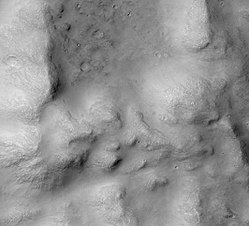
Boeddicker Crater Floor, as seen by HiRISE.

West side of Boeddicker Crater, as seen by CTX camera (on Mars Reconnaissance Orbiter).

Enlargement of previous image showing dunes on floor of Boeddicker Crater, as seen by CTX camera (on Mars Reconnaissance Orbiter).


See also[edit]
- Groundwater on Mars
- Geology of Mars
- HiRISE
- Impact crater
- Impact event
- List of craters on Mars
- Ore resources on Mars
- Planetary nomenclature
References[edit]
^ "Gazetteer of Planetary Nomenclature | Boeddicker". usgs.gov. International Astronomical Union. Retrieved 4 March 2015.
^ http://www.google.com/mars/
^ Golombek M. et al. (2001) LPS XXXII, abs. #1234.
^ http://webgis.wr.usgs.gov/mer and http://marsoweb.nas.nasa.gov/landingsites/mer2003.
^ Golombek, M., J. Grant,T. Parker, T. Schofield, D. Kass, P. Knocke, R. Roncoli, N. Bridges, S. Anderson, J. Crisp, A. Haldemann, M. Adler, W. Lee, S. Squyres, R. Arvidson, M. Carr,C. Weitz. 2002. DOWNSELECTION OF LANDING SITES FOR THE MARS EXPLORATION ROVERS. Lunar and Planetary Science XXXIII 1245.pdf

 | This article about an extraterrestrial geological feature is a stub. You can help Wikipedia by expanding it. |
 | This article about the planet Mars or its moons is a stub. You can help Wikipedia by expanding it. |
Categories:
- Aeolis quadrangle
- Impact craters on Mars
- Astrogeology stubs
- Mars stubs


(window.RLQ=window.RLQ||).push(function()mw.config.set("wgPageParseReport":"limitreport":"cputime":"0.300","walltime":"0.408","ppvisitednodes":"value":1137,"limit":1000000,"ppgeneratednodes":"value":0,"limit":1500000,"postexpandincludesize":"value":196717,"limit":2097152,"templateargumentsize":"value":33228,"limit":2097152,"expansiondepth":"value":13,"limit":40,"expensivefunctioncount":"value":0,"limit":500,"unstrip-depth":"value":0,"limit":20,"unstrip-size":"value":5030,"limit":5000000,"entityaccesscount":"value":1,"limit":400,"timingprofile":["100.00% 216.844 1 -total"," 39.88% 86.478 1 Template:Infobox_Mars_crater"," 35.79% 77.607 1 Template:Infobox_crater_data"," 33.88% 73.460 1 Template:Infobox"," 20.13% 43.651 1 Template:Geography_of_Mars"," 18.55% 40.214 1 Template:Navbox_with_collapsible_groups"," 18.17% 39.400 1 Template:Reflist"," 15.57% 33.754 1 Template:Coord"," 14.48% 31.409 1 Template:Cite_web"," 5.00% 10.849 1 Template:Portal_bar"],"scribunto":"limitreport-timeusage":"value":"0.081","limit":"10.000","limitreport-memusage":"value":3644962,"limit":52428800,"cachereport":"origin":"mw2188","timestamp":"20180917230641","ttl":1900800,"transientcontent":false);mw.config.set("wgBackendResponseTime":84,"wgHostname":"mw2233"););
 Clash Royale CLAN TAG